
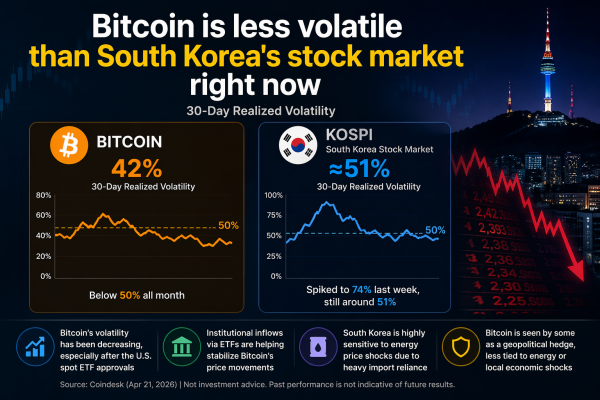
Bitcoin (BTC) volatility has recently fallen below that of the KOSPI, South Korea's benchmark stock index, data showed.
CoinDesk reported on Monday that bitcoin's 30-day realised volatility is currently about 42 percent and has remained below 50 percent throughout April.
Over the same period, the KOSPI's volatility was much higher. The KOSPI jumped at one point last week to 74 percent and is still running at around 51 percent. Pakistan's KSE100 index also showed higher volatility than bitcoin, at about 51 percent. Bitcoin, long seen as a representative asset with sharp price swings, has recently shown a steadier trend than some stock markets.
A change in the structure of capital flows is cited as a backdrop to the shift. Analysts say that after spot bitcoin exchange-traded funds (ETFs) were introduced in the United States in January 2024, growing institutional inflows have clearly eased price volatility. Inflows reflecting risk-management strategies helped reduce abrupt price moves, they said.
Bitcoin is also being cited as relatively emerging as a store of value during periods of geopolitical instability. As tensions recently rose in the Middle East, energy prices surged, but bitcoin showed a structure that was relatively free from such shocks. Stock-market volatility increased more in countries heavily dependent on crude oil and natural gas imports, while bitcoin was less directly affected, the explanation said.
The KOSPI in fact went through large swings in tandem with the Middle East war environment. It plunged from around 6,340 points at the end of February to 5,000 points at the end of March, then later rebounded to above 6,380. In the process, a surge in oil prices due to the closure of the Strait of Hormuz was cited as a key factor that heightened market volatility. Pakistan's stock market also showed high volatility for similar reasons.
By contrast, bitcoin maintained a relatively stable trend over the same period, trading between about $65,000 and $75,000. Renewed inflows into U.S.-listed spot ETFs supported prices, and its structure not being directly exposed to energy-market shocks also contributed to stability, analysts said.
It was also pointed out that bitcoin is not always more stable when compared with all global markets. Some major stock markets still maintain lower volatility than bitcoin. Even so, the fact that bitcoin's volatility over the past month has fallen below that of some countries' stock markets raises the possibility that market views on its asset characteristics may change.
The trend is seen as a case showing that perceptions are expanding beyond bitcoin as a simply high-risk asset, with recognition growing that it can show relative stability in certain environments.
 Jinju Hong
hongjj@d-today.co.kr
Jinju Hong
hongjj@d-today.co.kr