
Sales of South Korean beauty products are rising in the U.S. market, a trend that local media have also covered prominently.
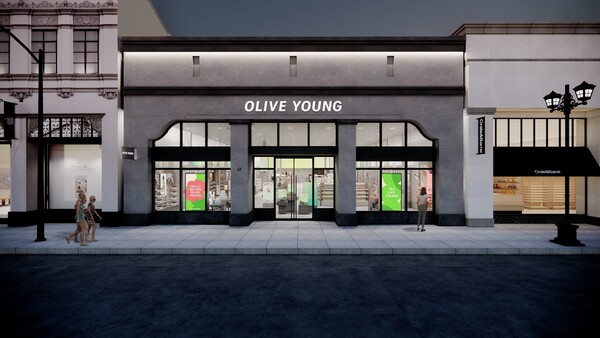
CNBC reported on July 18 that Korean beauty retailer Olive Young opened its first U.S. store in late May and recently launched a second store in Century City. It also plans additional openings.
The company said the Pasadena, California store drew 6,000 visitors over its opening weekend and still attracts an average of more than 1,600 a day.
Lena Kim (레나 김), head of global communications at Olive Young, said, "The United States is not only the world’s largest beauty market, but also one of the most influential markets driving global beauty trends, content and consumer behavior." She said it was "a natural next step" in the company’s global expansion strategy.
K-beauty consumption in the United States has risen steadily from the "first wave" that began in the 2010s through the COVID-19 pandemic.
Anna Mayo (안나 메이요), a beauty analyst at NielsenIQ, said, "People stayed home and learned 10-step skincare routines, and got to know ingredients and how to combine products." She said a boom in "glass skin," a term for smooth skin, emerged and a trend took hold that emphasizes healthy, radiant skin itself rather than covering it with makeup.
Mayo said a "second wave" is now taking hold. NielsenIQ said U.S. K-beauty sales reached $2.8 billion in early 2026, up about 48 percent from a year earlier. Household penetration of K-beauty in the United States also rose to 28.7 percent over the past year.
Target said it quadrupled its K-beauty assortment last spring, adding more than 150 new products and more than 10 new brands.
Simon Gutman (사이먼 구트만), an analyst at Morgan Stanley, expected K-beauty growth to continue. In a report in March, he forecast that U.S. K-beauty sales could reach about $4 billion in 2026, citing the popularity of K-culture and demand for functional skincare.
Beauty expert Cassandra Bankson (캐산드라 뱅크슨) said K-beauty’s popularity would open the door to cosmetics from other countries. She said Chinese and Japanese products would be next, followed later by products from Vietnam, Singapore and Thailand.
Anna Glaessgen (애나 글레스겐), an analyst at B. Riley Securities, said, "Seeing Olive Young stores settle in shows there is substantial demand for K-beauty," but pointed to a risk that K-beauty is cheaper than prestige skincare and could lower average selling prices.
 Chi-gyu Hwang
delight@d-today.co.kr
Chi-gyu Hwang
delight@d-today.co.kr