
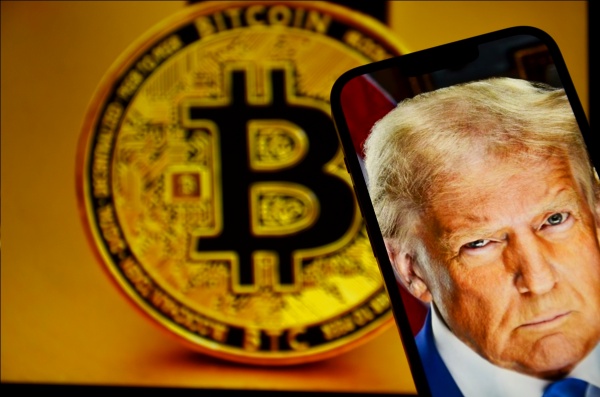
[DigitalToday reporter Jinju Hong (홍진주)] Bitcoin (BTC) is again showing a clear pattern of reacting instantly to remarks and social media posts by U.S. President Donald Trump. As geopolitical and policy messages repeatedly jolt prices by the minute, analysts say the nature of market volatility is also changing.
On April 20 local time, blockchain media outlet Coindesk reported that bitcoin and risk assets have continued to surge and slide after Trump’s remarks on Middle East developments, tariffs and cryptocurrency policy. The market is responding faster to the messages themselves than to simple macro variables.
Behind the latest discussion are recent remarks about the Strait of Hormuz. After Trump hinted on April 18 at ending the war and reopening the strait, bitcoin broke above $78,000 for the first time in about two months. But as uncertainty over the terms of any agreement grew and Iran raised the possibility of reblocking the strait, the price slipped back below $76,000.
This is not the first time markets have reacted sensitively to Trump’s remarks. In July 2019, after Trump expressed a negative stance on cryptocurrencies, bitcoin fell 7.1 percent in about 45 minutes. He argued at the time that cryptocurrencies were not money and were based on thin air.
By contrast, buying interest quickly followed messages that shifted the policy direction. In March last year, Trump confirmed that the United States would include multiple cryptocurrencies, including bitcoin, in a strategic national crypto reserve. Bitcoin then rose 8.2 percent in less than a day, jumping from $84,000 to above $91,000.
Remarks linked to tariff policy also delivered a strong shock to the market. In October the same year, after Trump said he would impose 100 percent tariffs on all Chinese imports in response to China’s restrictions on rare earth exports, bitcoin fell 12.4 percent in about two hours. It slid from around the record high of $124,714 toward $102,000, and liquidations totaling $19.38 billion occurred over 24 hours.
Messages directly tied to crypto policy showed a similar pattern. In March, Trump criticised Wall Street banks for, as he put it, undermining the GENIUS Act and delaying passage of the CLARITY Act by taking issue with stablecoin profit provisions. Bitcoin rose 5.2 percent within 10 minutes of the remarks. A shift in expectations about the regulatory direction was immediately reflected in the price.
Remarks suggesting the possibility of easing tensions in the Middle East also triggered a short-term surge. On April 14, after Trump said Iran had sounded out the possibility of peace talks following the closure of the Strait of Hormuz and that an agreement was very possible, bitcoin rose 6.2 percent in 30 minutes. It moved from $70,000 to near $75,000.
Such frequent sharp moves are spreading beyond simple volatility into debate over market manipulation and insider trading. A recent study by Oxford University’s law faculty pointed to major swings in global markets after abrupt changes in U.S. tariff policy. After new tariff announcements, crypto and stock prices fell together, then rebounded days later after Trump reversed some measures. The researcher said the scale and timing of the moves created trading opportunities that benefited certain investors with advance information.
In politics as well, there have been calls to examine trading flows around major remarks. Senator Adam Schiff called for an investigation in April 2025 after Trump posted on Truth Social, "now is a good time to buy," and markets rebounded on an announcement adjusting tariffs. Representative Stephen Lynch also said trading activity linked to Trump’s major announcements raised serious concerns about insider trading and market manipulation by government officials with access to national security-sensitive information.
Even so, no clear evidence has been confirmed so far that Trump or his administration was involved in legal violations or intentional market manipulation. Still, as the gap between policy decisions and market reactions has become extremely short, concerns are growing about a structure in which political messages act as market signals.
In the market, analysts say short-term volatility is likely to expand depending on Middle East developments and additional U.S. messages. They say investors need to watch policy remarks themselves as a key risk factor.
 Jinju Hong (홍진주)
hongjj@d-today.co.kr
Jinju Hong (홍진주)
hongjj@d-today.co.kr