
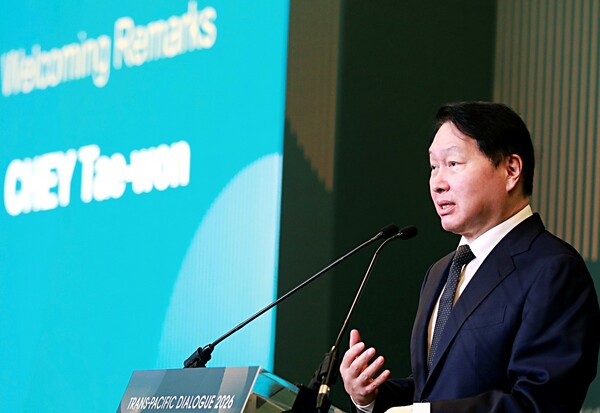
A ruling has ordered SK Group Chairman Choi Tae-won (최태원) to pay 944 billion won in asset division money to Roh So-young (노소영), director of Art Center Nabi. Seoul High Court’s Family Division 1, presided over by Chief Judge Lee Sang-joo (이상주), handed down the ruling at 2 p.m. on Thursday at the remanded retrial in the asset division case. The amount is more than 400 billion won lower than the 1.38 trillion won calculated by the second-instance court.
The court ruled that the SK Inc stake held by Choi is subject to division. After the ruling, the court said it took into account that the value of the shares held had risen sharply. It is interpreted as an assessment that reflects part of the rise in the share price.
Immediately after the ruling, Choi’s side issued a statement in the name of its legal representative. It referred to the course of events, saying the divorce was finalised by a Supreme Court ruling last year in the nearly 20-year process of dissolving the marriage, and that the asset division decision was made on Thursday. It also conveyed regrets for causing concern.
The remanded retrial had two issues. They were whether SK shares are included in the assets subject to division and when to set the reference date for valuation. The two sides differed over the reference date. Choi’s side was reported to have argued that the 기준 should be April 16, 2024, the date closing arguments ended at the appellate court when the divorce was finalised. Roh’s side said the reference date should be the date closing arguments ended in the remanded retrial.
The difference in SK’s share price between the two dates was large. At the time closing arguments ended at the appellate court, the SK share price was around 160,000 won and the value of Choi’s stake was about 2.07 trillion won. By contrast, SK shares were 862,000 won on Thursday, and a simple calculation of Choi’s 17.9 percent stake comes to 11.2 trillion won. Depending on the reference date, the size of the assets subject to division would differ by more than fivefold.
Earlier, the Supreme Court last year upheld only the 2 billion won portion on consolation money and sent back the asset division decision for retrial. On the 30 billion won funds of former President Roh Tae-woo, which was a key basis for the second-instance court to recognise Roh’s contribution, the Supreme Court held the money fell outside the protection of the law as it amounted to bribes, while reserving judgment on the substance.
The first-instance court viewed SK shares as Choi’s separate property and excluded them from division, ordering 66.5 billion won in asset division money. The second-instance court recognised the shares as marital property and set the split at 65 to 35, calculating 1.38 trillion won.
Separately, Choi’s side has argued there were errors in calculating the share value. The legal representative said the value of Daehan Telecom shares acquired by Choi in 1994, now SK C&C, would be 1,000 won per share as of May 1998 rather than 100 won if two stock splits are reflected. It said applying that would make the contribution of the previous chairman 125 times rather than 12.5 times, and Choi’s contribution 35.5 times rather than 355 times. The argument is that Choi should be viewed as having inherited through succession rather than self-made, and that Roh’s contribution through support in the marriage should therefore be recalculated.
Possible further appeal remains; worst governance scenario avoided
After the remanded retrial result, the remaining legal procedure is a further appeal. A party objecting to the remanded retrial ruling can file an appeal. The scope of review in a further appeal is narrower than in the first appeal. Because the remanded retrial is bound by the Supreme Court’s legal 판단, it is difficult to dispute again the parts that followed the remand purpose as is.
For that reason, potential issues are the areas newly judged in the remanded retrial: whether SK shares are included in the assets subject to division, the split ratio and whether there is a misunderstanding of law in setting the reference date.
From Choi’s perspective, it is assessed that the worst scenario was avoided in terms of SK Group’s governance structure. As the division amount fell by several hundred billion won compared with the second-instance ruling, Choi has for now avoided a situation in which he would have to sell a large amount of SK Inc shares, which are key to his control of the group. Still, since the absolute amount remains large, attention is focused on how funds will be raised.
The ruling is also drawing attention as a reference point for divorce lawsuits involving owner families. Depending on whether a further appeal is filed and the direction of implementation of the decision, a precedent is expected to be created on whether stakes directly tied to management control can be treated as divisible assets and how far a spouse’s contribution will be recognised.
 Seok Dae-geon
d2dg@d-today.co.kr
Seok Dae-geon
d2dg@d-today.co.kr