
The United States has finalised a decision to impose a 12.5% tariff on South Korean products on the grounds of forced labor. That leaves a 2.5 percentage-point gap to the 15% tariff ceiling agreed by South Korea and the United States last year.
The Office of the U.S. Trade Representative (USTR) said on July 23 local time it would impose a 10 to 12.5% forced labor tariff on 60 economies under Section 301 of the Trade Act. The new tariffs take effect at 12:01 a.m. local time on July 24. It coincides with the end of a global 10% tariff that had been operated under Section 122 of the Trade Act.
USTR split the 60 economies under investigation into four groups and applied different rates. South Korea was placed in Group 1 with Japan and Switzerland. In Group 1, if an existing most-favoured-nation (MFN) tariff is below 12.5%, a Section 301 tariff is added to bring the total to 12.5%. If the MFN tariff is 12.5% or higher, the Section 301 tariff is set at 0% to keep the existing rate. The European Union and Taiwan are in Group 2 with the same approach but a 10% baseline. Seventeen countries, including Canada, Mexico, Britain and India, are in Group 3, where 10% is added to the MFN tariff. Thirty-eight countries, including China and Brazil, are in Group 4, where 12.5% is added.
USTR said imports from the 60 economies targeted in the move account for 99% of total U.S. imports. That effectively includes all major trading partners. Automobiles, steel and semiconductors covered by Section 232 of the Trade Expansion Act, and some raw materials, were excluded from the action.
The tariff rate itself fell short of the level sought by the South Korean government. The government and the Korea International Trade Association submitted written opinions to USTR and attended a public hearing to call for the measure to be withdrawn, and asked for it to be lowered to 10% if withdrawal was difficult. USTR finalised the 12.5% rate it had announced last month.
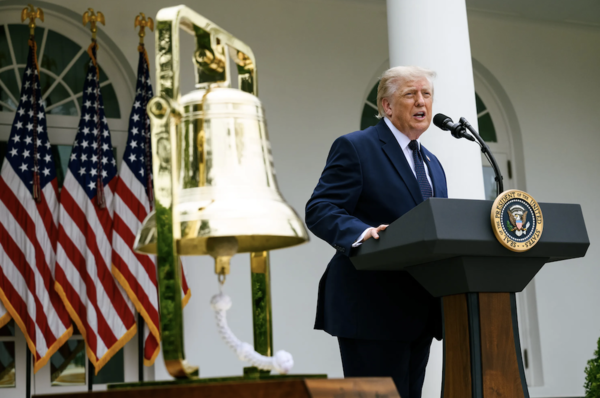
USTR chief Jamieson Greer (제이미슨 그리어) said President Trump recognises that moral persuasion to eradicate forced labor has failed to produce results for decades. He said it is time for U.S. trading partners to adopt a ban on imports of forced-labor products that the United States has maintained for nearly a century.
Government sought a cut to 10%, but the announced level stands
A separate Section 301 investigation that USTR is conducting into overproduction has yet to reach a conclusion. If the combined total of the two tariffs exceeds 15%, it would be worse than last year’s trade agreement. South Korea agreed to lower reciprocal tariffs to 15% from 25% in exchange for pledging $350 billion in investment in the United States, worth about 518 trillion won.
The government’s response proceeded on two tracks. One was responding to the investigative process itself. The government and the Korea International Trade Association have countered U.S. claims by submitting opinions and attending public hearings during USTR’s investigation. They also asked for the rate to be lowered to 10% if removing the tariff proved difficult, but that was not reflected in this announcement.
The other was to seek a solution through high-level contacts. The industry said that ahead of the announcement, Industry and Trade Minister Jeong-gwan Kim (김정관) and Trade Minister Han-koo Yeo (여한구) made an urgent visit to the United States and held a series of meetings. Kim met U.S. Commerce Secretary Howard Lutnick on July 22 to 23, and Yeo met Greer on July 21.
The core argument delivered by the government at the meetings was not the individual tariff rate but the combined ceiling. It said the total should not exceed 15% even after adding the forced-labor tariff and an overproduction tariff. The Industry Ministry said on July 24 the U.S. side reaffirmed its position that it would keep the existing agreement. It said it could not stop the 12.5% figure itself, but it received confirmation again from the U.S. side of the ceiling. It said tariff uncertainty had been resolved to a significant extent.
The government is seeking to accelerate talks by using last year’s agreement on $350 billion in U.S. investment as a bargaining chip. Kim attended an opening ceremony on July 23 in Washington, D.C. for the Korea-U.S. Shipbuilding Cooperation Center and reaffirmed the investment commitment. He said the first project, focused on the energy sector, could be announced as early as late August.
The next key issue is the timing and size of any overproduction tariff. The overproduction investigation takes longer than the forced-labor probe because it must closely examine production and export structures by country and by industry. A Section 301 probe that USTR conducted in 2017 against China alone took about 11 months before tariffs were imposed, and this time 16 economies, including South Korea, are being targeted at the same time. Even after the findings are announced, it must go through collection of opinions and public hearings.
U.S. political scheduling is also a variable. An outlook has emerged that the Trump administration, which presents tariff policy as a measure of policy achievement, could bring forward the verification process to produce results before the midterm elections in November. The remaining room is 2.5 percentage points. The government said the next phase will hinge on whether an overproduction tariff is set within that range or whether the 15% ceiling is shaken.
 Dae-geon Seok
d2dg@d-today.co.kr
Dae-geon Seok
d2dg@d-today.co.kr