
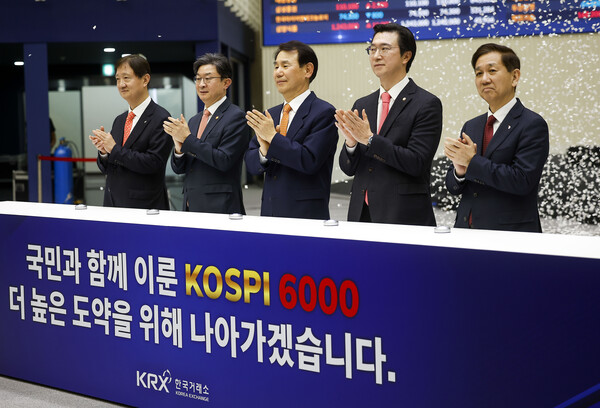
South Korea's KOSPI index on Tuesday broke above the 6,000 mark for the first time ever. The milestone comes just one month after it first crossed 5,000 on Jan. 27, marking the fastest 1,000-point rise on record.
The Korea Exchange held a ceremony at 4 p.m. on Tuesday at its 홍보관 to mark the KOSPI's first-ever move above 6,000 points.
Attendees including Kang Min-kuk (강민국), opposition floor leader on the National Assembly's Political Affairs Committee, Financial Services Commission Chairman Lee Eok-won (이억원), Financial Supervisory Service Governor Lee Chan-jin (이찬진) and Korea Financial Investment Association Chairman Hwang Seong-yeop (황성엽) congratulated the market on reaching 6,000.
The KOSPI climbed as high as 6,144.71 points during the session before closing at 6,083.86.
Market capitalisation rose to a record 5.017 quadrillion won, up more than 750 trillion won from 4.204 quadrillion won when the index first crossed 5,000.
In congratulatory remarks, Lee Eok-won said the stock market is shedding the label of a Korea discount and beginning to leap toward a Korea premium. He said policy efforts for a dynamic and vigorous capital market will continue.
The KOSPI's rise this year is 44.4 percent, the highest among G20 countries. It has outpaced Turkey at 25 percent, Brazil at 19 percent and Japan at 14 percent. The index is recording the best performance in the G20 for a second consecutive year, following a 76 percent rise last year.
Sector rotation is cited as a backdrop for the rise. While the electric and electronics sector leads on expanding demand for AI memory semiconductors and strong earnings, defence-related stocks gained on geopolitical risks in the Middle East.
Shipbuilding and nuclear power (machinery and equipment) and construction also gained on major overseas project orders and clearer prospects for exports of power generation facilities. The rally broadened across electric and electronics at 59.1 percent, construction at 65.7 percent, machinery and equipment at 36.9 percent and finance at 41.8 percent.
The effects of the government's capital market policies are also continuing.
After a first revision of the Commercial Act on July 3, 2025, a second revision on Aug. 25, and the introduction of separate taxation on dividend income on Jan. 1 this year, a third revision bill including the cancellation of treasury shares passed the National Assembly's Legislation and Judiciary Committee on Feb. 20. This has accelerated a recovery in market trust and a re-rating of corporate value.
This move above 6,000 comes just one month after entering the 5,000 range, sharply shortening the previous record pace.
It is a signal that raises the standing of South Korean stocks in global capital markets. It suggests that even after the move above 5,000, the market has maintained a higher rise than major countries, leading to a re-evaluation of stability and entry into a medium- to long-term uptrend.
Growth drivers have also diversified. A broad range of sectors including semiconductors, industrial goods and finance contributed to gains, narrowing performance gaps among sectors compared with last year, expanding the market base and shifting toward a sustainable growth structure.
The Korea Exchange forecast the rising trend is likely to continue if broad earnings improvements across sectors and the effects of policies to revitalise capital markets persist.
Korea Exchange Chairman Jung Eun-bo (정은보) said the KOSPI, which posted a 75.6 percent rise last year, is also recording gains of more than 30 percent so far this year, sustaining an overwhelming uptrend among major countries' stock markets. He stressed that the move above 6,000 shows it is not a temporary index rise but an accumulated result of structural change in capital markets and improvements in industrial competitiveness.
He added that efforts will continue until the capital market is firmly established as a global premium market.
 Oh Sang-youp
yub@d-today.co.kr
Oh Sang-youp
yub@d-today.co.kr