
[DigitalToday reporter Jinju Hong] Robotics startup Physical Intelligence unveiled a new robot model, 'pi 0.7', that can carry out tasks not included in its training data. Unlike earlier robots optimized for a single task, it shows an ability to combine different experiences to handle new tasks, a step toward building a general-purpose robot, it is assessed.
TechCrunch reported on April 16 (local time) that pi 0.7 demonstrated early-stage 'compositional generalization'. This refers to a robot's ability to combine individual movements and knowledge learned in the past to respond to unfamiliar environments and tasks.
A typical robot training approach has been to learn large volumes of data for a specific task and repeat the same task. By contrast, pi 0.7 goes beyond simply memorising individual tasks and focuses on expanding to unfamiliar tasks by combining web-based pretraining information with physical action data. Physical Intelligence views this as an early step toward a general-purpose robot brain.
A representative example is an air fryer experiment. Researchers said there were effectively only 2 pieces of training data directly related to the device. Even so, pi 0.7 attempted to cook sweet potatoes without additional training and successfully completed the task when a human provided step-by-step language instructions.
Co-founder Sergey Levine (세르게이 레빈) said, "If you move beyond a stage where you perform only precisely trained tasks and move to a stage where you combine them in new ways, the magnitude of performance improvement grows." He added, "This is similar to scaling characteristics seen in language and vision models."
The model's key significance is that it can improve performance in the field without collecting additional data or retraining even after being deployed in a new environment. It has not yet reached full autonomy. It is difficult for it to carry out complex multi-step tasks with a single high-level command, and it operates reliably at a level where step-by-step instructions are provided.
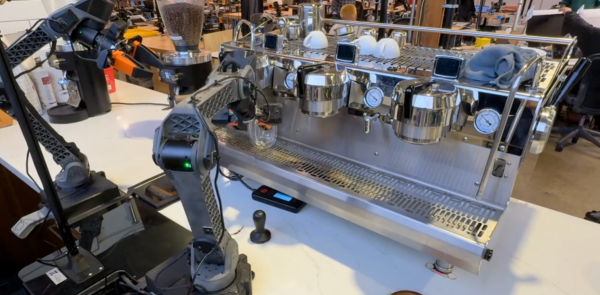
Researchers also acknowledged technical limits. They said the robotics field lacks unified standard benchmarks, making external verification difficult. Physical Intelligence therefore compared pi 0.7 with its existing task-specific models and said it confirmed similar performance on complex tasks such as making coffee, folding laundry and assembling boxes.
An interesting point is that performance is not determined solely by model capability. Researcher Ashwin Balakrishna (애슈윈 발라크리슈나) said the success rate in the initial air fryer experiment stayed at about 5 percent, but rose to 95 percent after improving the way the task was explained for about 30 minutes. He said, "Often the cause of failure is not the robot, but the way humans explain," underscoring the importance of prompt design.
Researchers also saw results they did not expect. Balakrishna said that when he gave the robot an arbitrary gear set and instructed it to rotate it, he confirmed it performed the task without separate training. Levine also cited cases in which early large language models (LLMs) produced unexpected results and assessed that similar emergent capabilities are appearing in robotics as well.
It said more time is needed before commercialisation. In a paper, researchers defined pi 0.7 as an early signal of generalisation and an initial demonstration of new capabilities, and made clear it remains at a research stage.
Even so, expectations in the market are growing. Physical Intelligence has raised more than $1 billion so far and was recently valued at $5.6 billion. The industry is also discussing the possibility of attracting new investment that would lift the valuation to about $11 billion.
 Jinju Hong
hongjj@d-today.co.kr
Jinju Hong
hongjj@d-today.co.kr