
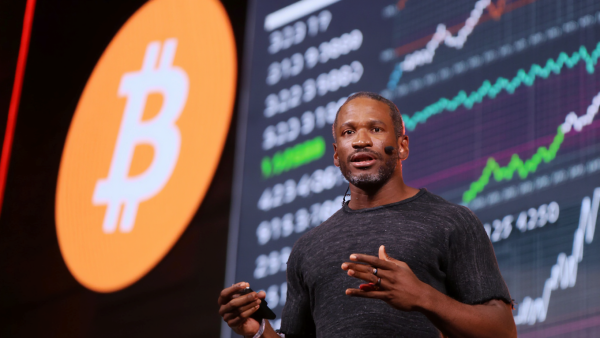
As views diverge on the direction of the cryptocurrency market, BitMEX co-founder Arthur Hayes (아서 헤이즈) argued that the key factor behind a bitcoin rebound is whether the U.S. Federal Reserve supplies liquidity.
On April 16 local time, blockchain outlet Cryptopolitan reported that Hayes summed up the current market phase into three key paths investors could consider and one intermediate case.
Hayes said an apocalyptic scenario on the scale of nuclear war was too difficult to use for investment decisions and excluded it. Instead, he said asset-allocation strategies should be reviewed around scenarios in which the war stops, Iran maintains control of the Strait of Hormuz, or the United States reopens the strait by force.
Hayes said the first variable was not the Middle East situation but a jobs shock inside the U.S. economy. He said that even if the war stops, a bigger problem is a trend in which artificial intelligence is replacing U.S. white-collar jobs. He said about 70 percent of U.S. gross domestic product is driven by consumer spending, and that because consumption depends on bank credit, bad loans could grow. He warned an AI-driven downturn could become as serious as the 2008 subprime crisis.
In this process, he introduced an example of a cryptocurrency game startup. The company tested Anthropic's latest AI model Claude around Christmas 2025, quickly produced usable code and then adopted an agent-based workflow to automate coding and code review on a continual basis. As a result, it even made plans to cut 50 percent of its workforce.
Hayes said this could raise the productivity of top engineers by 10 times to 100 times, but average workers could be pushed out of the labour market. He also noted that the median annual unemployment benefit across U.S. states is about $28,000, while most knowledge workers earn annual pay of $85,000 to $90,000.
Even in such a situation, he judged that the scale of any bitcoin rebound could be limited. Hayes said bitcoin could be confined to a limited rebound around $80,000 to $90,000 until the Fed actually supplies liquidity.
The second variable is a case in which Iran actually controls the Strait of Hormuz and allows passage only for ships from friendly countries.
He assumed Iran could collect transit fees of $2 million in yuan, cryptocurrency, sanctioned dollars or other transaction methods. He argued this structure could directly shake the petrodollar system, meaning major countries running trade deficits with China could sell U.S. Treasuries or U.S. technology stocks, buy physical gold and then seek to convert it into yuan in Shanghai or Hong Kong.
Hayes said foreign securities holdings tallied at the Fed have fallen by about $63 billion since the outbreak of the war, and that non-monetary gold from the United States ranked among the top export items in 4 of the past 5 months. He added that because Iran cannot use the SWIFT payments network, an increase in transaction volume on China's yuan international settlement network is also an important variable.
He also said, "The yuan and gold are most likely to become the two key currencies of trade between countries," and asked, "If holding dollars cannot guarantee that someone will not attack your cargo, why should you hold dollars?"
The third variable is a scenario in which the United States reopens Hormuz by force.
Hayes said in that case, trust in the dollar could recover temporarily, but Iran would be hit. If energy production in the Gulf region collapses, he said central banks would have little choice but to resume supplying liquidity amid a surge in commodity prices. He also said some countries could face hyperinflation, and that only the United States and Russia could remain as suppliers with the capacity to ramp up output on a large scale.
Even in that case, he said bitcoin strength would not last long. Hayes said, "If punitive bombing of Iran ends the blockade and Iran then destroys all energy production in the Persian Gulf, the bitcoin rally could be short-lived." He judged that even if monetary expansion lifts prices, risk appetite could weaken again if the collapse of Iran's state system raises the risk of World War Three.
From a market perspective, Hayes' message is closer to liquidity and changes in the payments order than an explanation of the war itself. He said key variables are the sequence in which expanded yuan settlement, an energy supply shock and a slowdown in U.S. consumption appear, while watching bitcoin, gold and bonds together. He added that bitcoin's direction could be driven more by the timing of Fed intervention and the strength of strains on the dollar system than by geopolitical events themselves.
No Trade Zone by Arthur Hayes
 Yoonseo Lee
yslee@d-today.co.kr
Yoonseo Lee
yslee@d-today.co.kr