
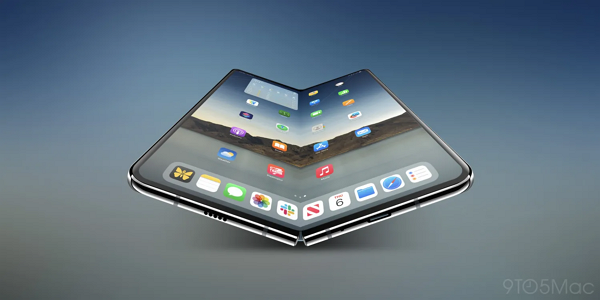
[Digital Today reporter Yoonseo Lee (이윤서)] Apple is expected to launch its first foldable iPhone this autumn and may name it the "iPhone Ultra".
According to IT outlet 9to5Mac on April 15 (local time), the device is likely to become Apple’s most expensive iPhone. It is expected to adopt a different screen structure, software and biometric authentication method from the standard bar-type iPhone.
The biggest change is the form factor. The iPhone Ultra is expected to use a book-style design that folds inward. When unfolded, it is likely to be wider than existing iPhones, which are tall in portrait orientation. The external screen is expected to be short and wide, while the internal screen is said to offer a feel closer to the iPad mini in size and aspect ratio. Another key point is that the inner panel may use a "crease-free" design with no visible fold line.
Its design may reflect part of the thin design of the iPhone Air. It would use a titanium frame and aim to be very thin when unfolded. There was also speculation it could look like two thin iPhone Air models stacked when folded. The colour options may be limited to black and white.
The display will have two screens, one outside and one inside. The outer display is discussed at 5.3 to 5.5 inches, and the inner display at 7.6 to 7.8 inches. The outer screen’s size may recall the iPhone mini, but its aspect ratio is expected to be wider. The inner screen is described as offering a hand-held experience closer to the iPad mini.
The camera is likely to be differentiated from the Pro lineup. It is expected to have two rear lenses, including a 48-megapixel main camera and a 48-megapixel ultra-wide camera, with a telephoto camera left out. If that happens, users choosing the Ultra model instead of a Pro model may have to accept some limits in zoom and telephoto shooting.
With two screens, it is also expected to have two front cameras, one on the outside and one on the inside. The front camera is discussed as having a configuration similar to the 18-megapixel Center Stage camera applied to last year’s iPhone 17, and the display may use a punch-hole design.
The software will centre on iOS 27. According to Bloomberg’s Mark Gurman, Apple could strengthen multitasking with iPhone Ultra-exclusive features. Features currently discussed include split-screen and an "app arrangement" method that places apps side by side. It is not expected to support functions similar to iPadOS 26 or to run iPadOS itself when unfolded.
The chipset and communications parts are also expected to be the latest specifications. The iPhone Ultra is expected to include the A20 Pro chip and the C2 cellular modem alongside the iPhone 18 Pro. It was also suggested the A20 Pro could be a bigger-than-usual efficiency upgrade by using a 2-nanometre process and WMCM (wafer-level multi-chip module) packaging.
Memory is expected to be 12GB RAM, the same as the A19 Pro, but it may use faster LPDDR5. The C2 is Apple’s next-generation in-house cellular modem designed to replace Qualcomm 5G modems.
An unexpected change is anticipated in biometric authentication. Despite its name, the iPhone Ultra is likely to adopt Touch ID rather than Face ID. Apple is reported to be considering integrating fingerprint recognition into the power button, and the implementation may be similar to the iPad Air and iPad mini. There was also speculation that the device could become so thin that it would be difficult to include Face ID components for each of the two screens.
Price forecasts are still mixed. Many analysts see the starting price at around $1,999 for the 256GB model, or about 2.94 million won, but some expect it could be lower or higher. Still, views lean toward it becoming the "most expensive iPhone". With Apple effectively choosing to combine the iPhone and iPad into one device, its pricing strategy is also likely to be set at the very top end of the premium segment.
On that basis, the iPhone Ultra is expected to be more than a simple new product and to serve as a test bed for reshaping Apple’s mobile lineup. It is discussed as being designed with a wider screen and usage style than existing iPhones, drawing in some iPad elements in software, and making different choices from the existing Pro lineup in biometric authentication and camera configuration. Key points to watch are whether the product name will be confirmed as iPhone Ultra this autumn and what differentiation Apple will put forward in the foldable market.
 Yoonseo Lee
yslee@d-today.co.kr
Yoonseo Lee
yslee@d-today.co.kr