
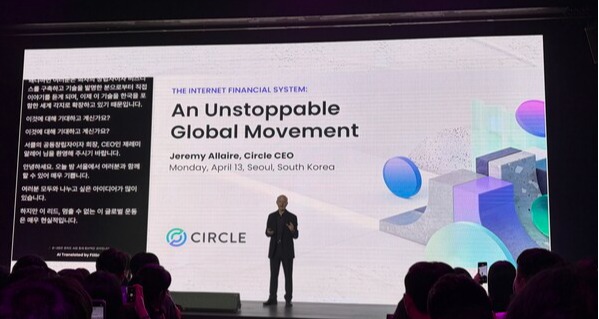
Circle CEO Jeremy Allaire (제레미 알레어) visited South Korea and stepped up his push, raising expectations for won-backed stablecoin-related stocks. The market is taking Circle’s schedule as a chance to gauge the institutionalisation of a won stablecoin and the possibility of cooperation on payment and settlement infrastructure.
At the “Circle in Seoul” event in Seoul on April 13, Allaire said it was encouraging that the South Korean government is reviewing digital asset laws. He said Circle is exploring ways to expand the number of companies it works with.
As part of that, he met major financial groups such as Shinhan, KB and Hana Financial. He also discussed cooperation with exchanges including Dunamu and Bithumb, then broadened contacts with the local industry at the company’s own event.
In the domestic stock market, major shares classified as a stablecoin theme rose sharply on April 14.
Satoshi Holdings rose 29.94 percent to hit the daily limit. ITCEN NS gained 16.61 percent, NHN KCP 9.80 percent, Aton 8.64 percent, Dream Security 5.42 percent, ITCEN Global 4.32 percent, KG Mobilians 3.55 percent, Kakao Pay 3.31 percent, Hecto Financial 3.28 percent, LG CNS 1.81 percent and NAVER 1.26 percent, with most rising.
The broad market response reflects that stablecoins are not only an issuer issue but are linked to the full spectrum of payment, authentication, settlement, wallet and trading infrastructure.
Lee Jun-ho (이준호), an analyst at Hana Securities, said Circle may pursue not only expanded USDC distribution during this visit but also cooperation on building infrastructure including the Circle Cross-Chain Transfer Protocol (CCTP). He said the catalyst may not remain only a short-term theme.
Lee also analysed that the Hong Kong Monetary Authority issued its first stablecoin licence on April 10, and that Japan is also moving to bring digital assets into the institutional financial product framework.
Circle met Upbit, Bithumb and Coinone during this visit and continued talks and memorandums of understanding with each.
Bithumb said it signed an MOU with Circle to seek opportunities for cooperation on digital asset infrastructure and stablecoin technology. Dunamu also announced a comprehensive agreement for innovation in the digital asset market. Coinone said it held talks on stablecoin infrastructure on the last day of the visit.
Experts said the current domestic policy discussions are also intersecting with these developments.
Shim Soo-bin (심수빈), an analyst at Kiwoom Securities, said revisions to the Electronic Securities Act and the Capital Markets Act passed a plenary session in January, putting regulations in place for forming a domestic token securities market. She said the need to introduce won-backed stablecoins and spot digital asset ETFs is also being mentioned consistently.
Shim said there is a high possibility that Korean-style tokenised finance will develop into a multi-layer structure in which a central bank digital currency, deposit tokens and stablecoins divide roles.
In that structure, she analysed, stablecoins could function as an expansion layer that handles inter-platform linkage and external payments rather than a final settlement means inside financial institutions.
Circle’s recent moves are also adding to these expectations. Circle expanded CCTP support on April 10 to assets beyond USDC, and set out a direction to support online micropayments based on fast transfers and the distribution of real-world assets.
Still, it remains to be seen whether this will translate into actual business results. The key drivers of the share moves are Circle executives’ visit schedule, MOUs and expectations for institutionalisation, and the speed of legislative progress and the scope of specific cooperation between financial groups and fintech firms are likely to become criteria for share differentiation.
Shim said the CLARITY Act, a U.S. digital asset clarity bill, continues to face disagreements among stakeholders over whether to allow stablecoin reward payments and requirements for a transition to decentralisation. She added that it is expected to take time for the bill to pass.
 Sangyeop Oh
yub@d-today.co.kr
Sangyeop Oh
yub@d-today.co.kr