
AI-based data security company Cohesity is accelerating its Enterprise AI Resilience strategy, expanding its data protection and security capabilities into the AI ecosystem.
The core of the Enterprise AI Resilience strategy is to help organisations adopt and scale AI with confidence by strengthening cyber resilience.
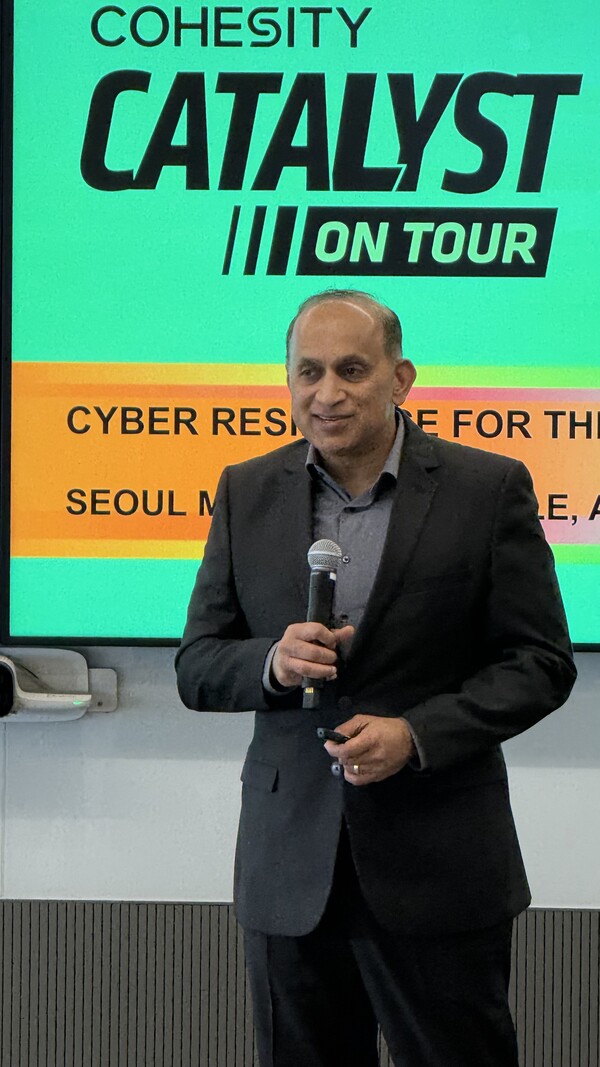
Cohesity CEO and president Sanjay Poonen (산제이 푸넨) held a media briefing in South Korea on Monday morning. "By strengthening defence and supporting secure data activation, Cohesity is establishing Enterprise AI Resilience as a foundation for responsible and accelerated AI adoption," he said. "Companies need confidence that they can manage AI-driven risks and recover quickly when disruptions occur. Cohesity provides the resilience foundation to protect AI infrastructure, enable data access governance, mitigate agent-based risks and unlock the innovative power of trusted enterprise data," he said.
The company said Cohesity's Enterprise AI Resilience strategy helps companies mount strong defences that protect AI systems and mitigate agent-driven risks, and use that to drive AI-led growth.
As AI systems move from experimentation to operations, companies need to extend cyber resilience across the full AI stack. To that end, Cohesity supports protection for AI and agent infrastructure, protection from malfunctions, unintended actions or malicious agent activity, and sensitive-data governance for AI.
"Companies must protect the infrastructure that builds and runs AI systems, including AI agents and memory, vector databases, model configurations and policies, training and fine-tuning datasets, and enterprise data stores," Poonen said. "Cohesity preserves immutable snapshots in AI environments and supports synchronised point-in-time recovery of agents, data and supporting infrastructure, reducing downtime without rebuilding the entire system," he said.
"Logic errors, corrupted inputs, prompt injection or malicious manipulation can trigger cascading automated mistakes within seconds. Detection alone is insufficient, and organisations must suppress unintended or malicious agent-based activity and recover quickly," he added. "Through deep integration with major control and observability platforms, including ServiceNow and Datadog, Cohesity converts agent risk signals into automated API-based recovery workflows," he said.
"As AI systems access sensitive enterprise data across cloud, SaaS and hybrid environments, continuous visibility and governance are essential. Cyera-based Cohesity DSPM discovers and classifies sensitive data and monitors access patterns. Combined with recovery capabilities, it can detect exposure or misuse and restore affected data and AI systems to a trusted state," he said.
The Enterprise AI Resilience strategy also supports AI-driven data analysis beyond simple data backup and protection. "After protecting data and ensuring security, it is important to draw insights with AI," Poonen said. "We will build AI analytics capabilities that cover unstructured data, including not only text but also hospital image files and video," he said.
To that end, Cohesity announced Model Context Protocol-based federated semantic search. It supports AI-based enterprise tools, including Glean, so they can securely access governed backup data without duplicating data or undermining compliance.
Cohesity will also launch the Cohesity Gaia Catalog. "We are expanding so protected data can be accessed directly from major analytics platforms such as Databricks and Microsoft Fabric, improving data freshness and governance and providing trusted enterprise context to AI systems," Poonen said.
Cohesity is also stepping up cooperation with various companies in the enterprise market. With Cyera, it launched the Cyera-based Cohesity DSPM (Data Security Posture Management) solution. Using the Cyera AI security platform, it automatically discovers and classifies sensitive data across cloud, SaaS and AI workflows, secures data visibility, mitigates compliance risks from AI adoption and supports recovery to a trusted state in the event of data exposure.
With ServiceNow, it supports companies in building and operating autonomous AI agents. If an incident occurs in which data is deleted or modified by an agent, it provides a function to restore in real time to a verified baseline using Cohesity immutable snapshots.
Cohesity integrates with the Datadog observability platform to detect anomalies in AI agents and cloud environments in real time and run API-based automated recovery workflows. It supports an immediate response to security incidents that spread at machine speed.
 Chi-gyu Hwang
delight@d-today.co.kr
Chi-gyu Hwang
delight@d-today.co.kr