
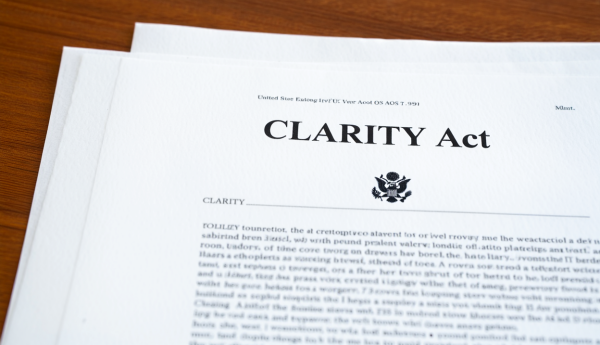
Coinbase CEO Brian Armstrong (브라이언 암스트롱) publicly backed swift action on the CLARITY bill urged by U.S. Treasury Secretary Scott Bessent (스콧 베센트). The move is interpreted as Coinbase effectively shifting toward support after opposing a provision that bans interest payments to stablecoin holders.
On April 10, blockchain outlet CoinPost reported that Bessent argued in a Wall Street Journal opinion piece that overhauling digital asset regulation is urgent. He said comprehensive legislation is needed to keep dollar-based innovation in the United States. He then used X, formerly Twitter, to again urge the Senate Banking Committee to speed up final consideration of the bill.
Coinbase has withheld support for the latest revised draft. The main sticking point is a provision that bars payments to stablecoin holders. Coinbase has said it worries the provision could reduce users' incentives to hold stablecoins and weigh on its profit-sharing structure, given that stablecoin-related revenue in 2025 reached $1.35 billion.
Signs of a shift have emerged recently. Armstrong expressed deep gratitude to bipartisan lawmakers and staff for working for months to strengthen the bill. Coinbase Chief Legal Officer Paul Grewal (폴 그레월) also said agreement is getting very close on key issues, including the question of stablecoin yields. That suggested the main points of conflict over the bill's wording have narrowed to some extent.
Bessent warned that regulatory uncertainty is pushing U.S. crypto companies into overseas markets such as Abu Dhabi and Singapore. He stressed that if the CLARITY bill is approved, next-generation financial innovation can be built on rails based on the U.S. dollar, while keeping leadership under the backing of U.S. institutions. He made clear that the debate is tied to competition over leadership in dollar-based financial infrastructure beyond simple industry regulation.
The Senate timeline has also come into view. Senator Cynthia Lummis (신시아 루미스) said last week that a bill markup, or final review, could take place at the Senate Banking Committee in late April. Decentralised finance regulation and rules limiting senior government officials' crypto holdings remain unresolved issues. That suggests that while the bill is broadening support, adjustments to detailed provisions are not finished.
Separately, the White House Council of Economic Advisers issued a report on April 8 disputing the banking sector's claims that stablecoins pose a risk of large-scale deposit outflows, saying it is difficult to support them with quantitative data. The council also said a ban on stablecoin yields does not effectively help protect bank lending. That is seen as material that could bolster Coinbase's argument in the debate over stablecoin compensation rules.
As a result, attention is turning to whether the Senate Banking Committee will actually move into final review in late April and how far the stablecoin compensation provision challenged by Coinbase will be adjusted. With public pressure from the U.S. Treasury secretary, a shift by the industry's largest exchange and a report by a White House advisory body converging, debate over the CLARITY bill is more likely to regain momentum.
 Yoonseo Lee
yslee@d-today.co.kr
Yoonseo Lee
yslee@d-today.co.kr