
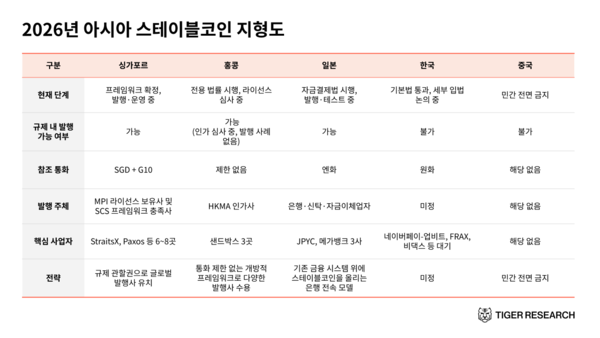
Web3-focused research firm Tiger Research said on Tuesday it has published a report titled "Asia Stablecoin Status." The report said Asia’s local-currency stablecoins account for less than 1 percent of the $300 billion global stablecoin market. It said speed of response is crucial before a dollar-centred ecosystem becomes entrenched.
As of February 2026, about 99 percent of all stablecoins are pegged to the dollar. The report said the U.S. government, through the GENIUS Act, is mandating that stablecoin reserves be held in U.S. Treasuries, using dollar stablecoins as a channel to sell Treasuries and as a tool to maintain dollar hegemony. The report said that the more citizens and companies use dollar-based stablecoins, the more funds are used to sustain U.S. dollar hegemony rather than their domestic financial systems. It explained that anxiety over not being able to cede monetary hegemony is a motive for Asian countries to issue local-currency stablecoins.
Singapore and Hong Kong have chosen a strategy of quickly attracting global issuers through open regulation, the report said. Singapore finalised rules in August 2023 allowing issuance in its local currency and G10 currencies, and 6 to 8 operators including StraitsX, Paxos, Ripple and Circle have already obtained licences and begun issuance. Hong Kong implemented an independent law in August 2025 with no restrictions on reference currencies, but it still has no formally approved issuers despite 36 companies applying, creating a lag between legislation and actual market launch.
Japan and China chose approaches that limit private-sector participation to protect monetary sovereignty, the report said. Japan legislated stablecoins in June 2023, the first in Asia, adopting a "bank-exclusive model" that restricts issuers to banks, trust companies and fund transfer operators. JPYC launched the first yen stablecoin in October 2025, and three megabanks - Mitsubishi UFJ Financial Group (MUFG), Sumitomo Mitsui Banking Corp (SMBC) and Mizuho - have also moved to jointly issue one, entering the practical issuance stage within a conservative framework. China chose a strategy of completely replacing private issuance by using the central bank digital currency, e-CNY, and in February 2026 explicitly banned unlicensed domestic and overseas issuance of yuan-pegged stablecoins.
South Korea passed the Digital Asset Basic Act in 2025, but completion of the system is being delayed as differences persist between the Financial Services Commission and the Bank of Korea over who can issue, the report said. The commission supports allowing private-sector participation including fintech, while the central bank argues for a consortium structure in which banks hold 50 percent plus one share. Outside regulation, KRWQ, a won stablecoin jointly developed by IQ and Frax, is supplying won liquidity to the global DeFi market, and major players have completed preparations to issue after legislation, including Naver Pay and Upbit, which are considering jointly issuing a won stablecoin.
The report’s author, Seung-sik Yoon (윤승식), head of the research centre at Tiger Research, said, "As global infrastructure anchored by dollar stablecoins is being built rapidly, local-currency stablecoins require detailed institutional design, but caution must not turn into delay." He added, "Participating after the network is entrenched and establishing a position from the beginning produces completely different outcomes, so it ultimately comes down to speed."
 Chi-gyu Hwang
delight@d-today.co.kr
Chi-gyu Hwang
delight@d-today.co.kr