
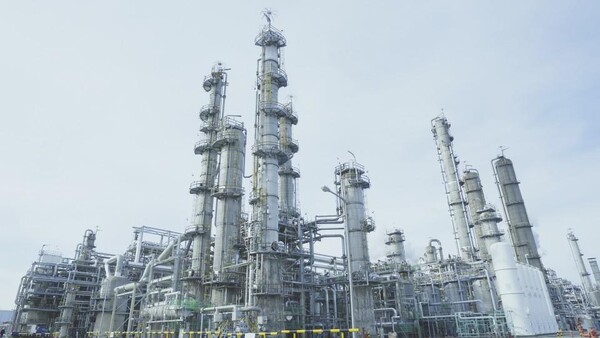
The government has approved the petrochemical industry’s first business restructuring project and will move to provide support worth 2.1 trillion won. The Ministry of Trade, Industry and Energy said on Feb. 25 it has given final approval to business restructuring plans submitted by HD Hyundai Oilbank, HD Hyundai Chemical and Lotte Chemical on Feb. 23. It is the first approved case since the government announced a roadmap for restructuring the petrochemical industry in August last year.
Under the plan, Lotte Chemical will spin off its Daesan site and merge it with HD Hyundai Chemical to operate naphtha cracking centre (NCC) and downstream facilities in an integrated way. HD Hyundai Oilbank and Lotte Chemical will raise a total of 1.2 trillion won in paid-in capital for the newly established integrated company as part of shareholder self-help efforts. Each will contribute 600 billion won, adjusting HD Hyundai Chemical’s ownership structure to 50-50 from 60-40.
In the process, 1.1 million tonnes of Lotte Chemical’s NCC capacity will be shut down. The two companies will also halt operations at overlapping and loss-making facilities among general-purpose downstream units. The government said it expects the move to ease oversupply in the Daesan industrial complex and raise utilisation rates at remaining facilities, improving efficiency. The restructuring period is 3 years.
The government has prepared a tailored support package jointly with relevant agencies covering finance, taxes, streamlined permits, cost structure improvements, the regional economy and jobs, and technology development. In finance, it will provide up to 2.0 trillion won. The Korea Development Bank and other creditor financial institutions plan to provide up to 1.0 trillion won each through new funding support and conversion to perpetual bonds. For tax support, the government will cut acquisition tax and registration licence tax arising during corporate spin-offs and mergers by 75 to 100 percent.
For cost structure improvements, 69.0 billion won to 115.0 billion won will be投入. For electricity, the plan will apply rates 4 to 5 percent cheaper than those of Korea Electric Power by using a distributed special zone scheme. It will ease rules banning duplicate heat supply to expand cheaper heat sources and broaden the scope for using directly imported liquefied natural gas (LNG) as fuel. It will extend the duty-free period for crude oil and naphtha and expand the scope of tariff quotas applied to crude oil used to produce naphtha.
The government will also invest an additional 2.0 billion won for streamlined permits and 26.0 billion won for technology development support. It will cut the corporate merger review period under the Fair Trade Act to 90 days from 120 days and exceptionally allow joint actions among restructuring companies. It will also streamline permit procedures, including simplifying licences for the petroleum sales business and allowing succession of chemical registrations. For technology development, it will quickly support 2 high value-added technology development tasks with 26.0 billion won starting this year.
The integrated company will move away from a structure centred on exports of general-purpose products and reshape its product portfolio around high value-added and eco-friendly products. It will integrate technology into existing general-purpose production processes to produce highly elastic lightweight materials for wires and cables and organic solvents for secondary battery electrolytes. It will also pursue production of internationally certified eco-friendly products using bio-naphtha and seek to introduce ethanol feedstock that can cut carbon emissions by up to 50 percent.
The government said it expects efficiency gains from integrated operations and shareholders’ self-help efforts to turn operating profit, which posted a loss last year, back to a profit after the restructuring period and to sharply reduce the debt ratio.
Industry Minister Kim Jung-kwan (김정관) said, "The Daesan No. 1 project is the first achievement produced through close cooperation between the government and the industry," adding, "It will serve as an opportunity to accelerate the restructuring of the petrochemical industry." He added, "It can succeed only if projects at all industrial complexes are completed, so we will actively communicate with companies so that follow-up projects can also proceed quickly."
 Seok Dae-geon
d2dg@d-today.co.kr
Seok Dae-geon
d2dg@d-today.co.kr