
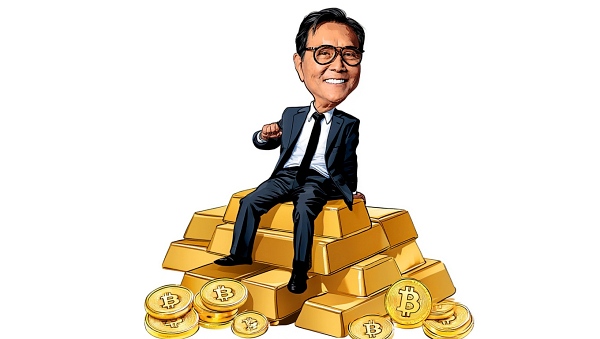
Robert Kiyosaki renewed his recommendation to hold gold, silver and bitcoin (BTC), warning at the same time of deepening inflation and instability in pension systems.
CoinPost, a blockchain media outlet, reported on April 6 that Kiyosaki recently wrote on X, formerly Twitter, that the current economic situation is the result of changes that began in 1974 becoming reality. He said it is not a short-term business cycle swing but a structural problem built up from institutional changes decades ago.
He pointed to two institutional changes in 1974 as a turning point. The first was the U.S. dollar moving to the "petrodollar" system tied to oil trading after fully breaking away from the gold standard. The second was the enactment of ERISA, the Employee Retirement Income Security Act, which shifted the focus from lifetime retirement pensions to defined-contribution pensions such as 401(k) and IRA in which individuals bear operational risk. Kiyosaki sees the investment risk as having been shifted to individuals rather than the state or companies in this process.
He also said recent price pressures are intertwined with this structure. Continued geopolitical tensions surrounding oil are pushing up energy prices, which could again stoke broader inflation, he said. He added that in a structure where baby boomers nearing retirement or already retired rely on defined-contribution pensions, market volatility and rising prices can act as a burden at the same time.
He also raised concerns about the social safety net. Kiyosaki said social security and Medicare are under financial pressure and argued that if the cost of living continues to rise, some older people could even face threats to housing stability. He warned that rising food and fuel prices could shake the foundations of survival.
In response, he proposed holding "real assets" and improving "financial education". Kiyosaki presented assets such as gold, silver and bitcoin as tools to defend against inflation and stressed that individuals must build the ability to manage their own assets. He added that "schools do not teach about money" and said a lack of financial knowledge increases individual risk over the long term.
He again referred to the concerns he has raised in past books, reiterating that the current economic environment is not a temporary crisis but the result of structural change.
 Jinju Hong
hongjj@d-today.co.kr
Jinju Hong
hongjj@d-today.co.kr