
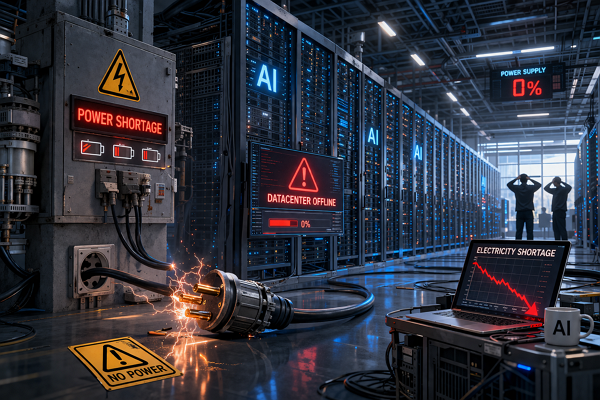
[DigitalToday Kyoungmin Hong (홍경민), intern reporter] Global big tech companies are moving to build data centres as they pour astronomical sums into meeting a surge in AI demand. But a severe shortage of key power-infrastructure equipment such as transformers and batteries has put about half of overall construction plans at risk of delay or cancellation.
Foreign media including online outlet Gigazine reported on April 4 local time that investment by four major big tech companies, Alphabet, Amazon, Meta and Microsoft, is expected to reach about $650 billion in 2026, or about 978 trillion won. But Bloomberg analysed that despite this unprecedented investment, many U.S. data centre construction plans are facing disruptions, and less than one third of facilities due to start operating in 2026 are actually under construction.
A key reason for the delays is a supply crunch in electrical equipment essential for power delivery, including transformers, switchgear and batteries, as well as shortages of chips. AI data centres consume far more power than typical facilities, making large-scale grid expansion essential. Demand for related components is also surging in other industries such as electric vehicles and heat pumps, pushing beyond manufacturing capacity.
A report by market research firm Sightline Climate said waiting times for delivery of high-power transformers, previously 24 to 30 months, have now stretched to as long as 5 years. Given that AI data centres have build cycles of less than 18 months, this has become a critical obstacle to pushing projects forward.
As U.S. manufacturing capacity hits its limits, big tech companies are turning to global supply chains including South Korea. Major analyses including those by Wood Mackenzie show South Korea has emerged as a top key country supplying high-power transformers for U.S. AI data centres, alongside Canada and Mexico. With strong wariness of Chinese-made equipment due to the U.S.-China trade war and national security concerns, South Korea is being judged as the 'surest alternative' because it combines technological capability with reliability.
The United States currently relies on China for more than 40 percent of battery imports and about 30 percent of certain transformer and switchgear categories. After decades of shifting manufacturing overseas, U.S. domestic production capacity has weakened, leaving it unable to fully reduce reliance on Chinese products despite tariff issues and security risks. In this process, the supply capacity of South Korean power equipment makers has become a key that will determine the direction of U.S. AI infrastructure.
Geopolitical risk also remains a variable. Tensions eased somewhat after a summit between U.S. President Donald Trump and Chinese President Xi Jinping in October 2025, but if shifts in relations cause supply-chain disruption, data centre construction plans are likely to face further delays. With the lack of just one element in the power infrastructure chain able to halt an entire project, securing power equipment has become a key variable in AI capacity, more so than capital strength or computing hardware.
Arvind Krishna (아르빈드 크리슈나), IBM's chief executive, warned that under current conditions it is nearly impossible to make a profit from AI data centre projects that are attracting such massive investment, and also voiced concerns about market overheating and worsening profitability.
 Kyoungmin Hong
hongm@d-today.co.kr
Kyoungmin Hong
hongm@d-today.co.kr