
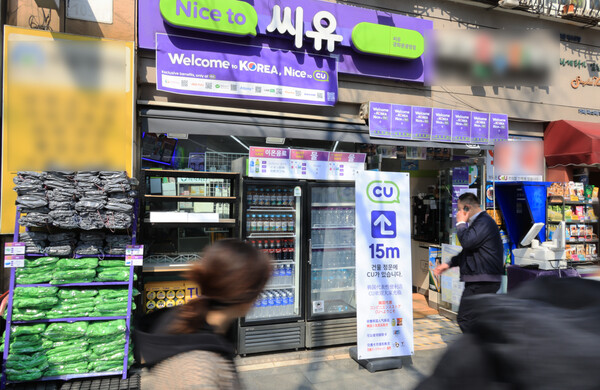
[DigitalToday reporter Ahn Shin-hye (안신혜)] As South Korea's convenience store market enters a saturated phase, the four major operators are moving to strengthen their private brand (PB) offerings. CU and GS25 are building up PB as a growth engine in overseas markets, while Seven Eleven and Emart24 are using PB to improve efficiency and profitability.
According to the industry on April 6, quantitative growth slowed last year for GS25, Seven Eleven and Emart24, unlike CU, which posted gains in both annual sales and store count.
CU and GS25, the No. 1 and No. 2 players, both recorded growth in annual sales but differed in store numbers. According to the Financial Supervisory Service's electronic disclosure system, last year's annual sales were 8.94 trillion won for GS25 and 8.86 trillion won for CU, both up 3.1 percent from a year earlier. Over the same period, CU's domestic store count rose by 253 to 18,711 from 18,458. GS25's total fell by 107 to 18,005 from 18,112.
Korea Seven, which operates Seven Eleven, posted annual sales of 4.82 trillion won last year, down 8.96 percent from a year earlier. Its store count fell by 1,112 to 11,040 from 12,152. Emart24 posted annual sales of 2.05 trillion won, down 5.1 percent, and its store count fell by 630 to 5,510 from 6,140.
As the convenience store market enters a mature stage, the industry is assessing that product competitiveness and profitability have become more important than simple store expansion. Major operators are therefore strengthening PB strategies aimed at price competitiveness and differentiation. According to the industry, PB shares by chain last year were 29.5 percent for CU, 20 percent for GS25 and 29.5 percent for Seven Eleven.
CU and GS25 are actively using PB brands at overseas stores, their next growth engine. As of the end of last year, CU operated 762 stores overseas in Mongolia, Malaysia, Kazakhstan and Hawaii. GS25 had 690 overseas stores in Vietnam and Mongolia.
In May last year, it revamped its existing PB brand HEYROO and launched PBICK as part of efforts to grow its PB business. CU's PB brands include PBICK as its master PB brand, get for freshly brewed coffee and delaffe for iced drinks.
The company said CU's PB brands posted annual sales growth of 16.0 percent in 2022, 17.6 percent in 2023 and 21.8 percent in 2024. CU set a goal of reaching 10 trillion won in sales and 300 billion won in operating profit by 2028, and it cited strengthening PB product competitiveness as a key strategy to achieve it.
GS25, which operates the PB brands YouUs and Real Price, is in a similar situation. GS25 sells PB brands at its overseas stores in Vietnam and Mongolia, and recently placed its PB ramen, including the Omori series, in 584 Don Quijote stores in Japan. At home, it moved to broaden its customer base by launching a dessert line under its "Hyejaroun" brand last month.
Seven Eleven also plans to enhance product competitiveness by revamping its PB brand 7-SELECT. However, with growth stagnant, it raised prices on PB products this year. According to the industry, Seven Eleven raised prices on about 40 types of snacks, drinks and desserts by up to 25 percent in January, and in February it also raised prices on food and fashion accessories.
Emart24 has expanded stores carrying E-Mart's PB brand No Brand since 2024 and launched a new PB brand, Yellow. South Korean convenience stores are also running "differentiated products" alongside PB brands, and Emart24 is increasing differentiated and partnered products such as Seongsu310 and Matcha310 along with Yellow and No Brand.
An industry official said South Korea's convenience store market has entered a mature stage, limiting store-count expansion. The official said each company's PB brand is increasingly becoming a key factor in securing competitiveness for additional growth.
 Ahn Shin-hye
doubletap@d-today.co.kr
Ahn Shin-hye
doubletap@d-today.co.kr