
A woman in her 30s, identified only as A, is thinking about what to wear as a wedding guest before an acquaintance’s wedding scheduled for mid-April. She wants a bright style suited to a warm weekend day while still neat, similar to office wear. She opened KakaoTalk’s 'ChatGPT for Kakao' tool and typed, 'Recommend an April wedding guest outfit for a woman in her 30s.' A recommended list of items on sale at Musinsa then appeared, along with ChatGPT’s styling explanation, allowing her to browse various styles available for purchase in one place at Musinsa.
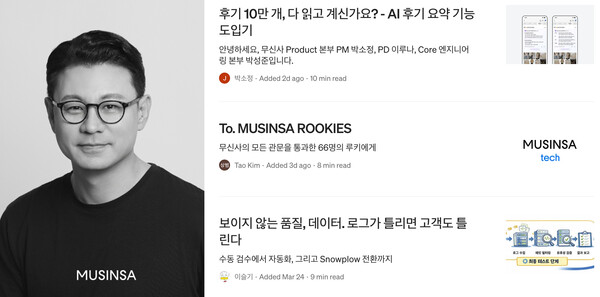
[Digital Today reporter Shin-hye Ahn] Musinsa is moving to revamp itself into an AI-native company. AI-native means designing business systems, work methods and products with AI as a core element from the outset, rather than using it as an auxiliary tool. Jun-hee Jeon (전준희), the chief technology officer leading Musinsa’s AI transition, said, "To improve the customer shopping experience, we are focusing on embedding AI across the board, including a win-win relationship with brands and internal work efficiency." He joined Musinsa at the end of 2024 and is leading its tech organisation.
◆Musinsa expands AI technology at consumer touchpoints
As part of that effort, Musinsa joined ChatGPT for Kakao within KakaoTalk last month and began a conversational commerce service. It allows consumers to search Musinsa’s fashion product data and receive recommendations without entering the Musinsa Store app.
According to Musinsa, the service applies its in-house Model Context Protocol (MCP) technology. It uses the concept of an agentic commerce protocol (ACP) to implement an AI-based shopping experience. It analyses context such as the user’s desired time, place and occasion, weather and brand preferences, helping deliver a hyper-personalised experience that connects exploration to reviews and purchases.
This is a recent case of Musinsa Tech’s 'AI-native' project being applied to an actual service, where Musinsa is focusing its efforts. Musinsa is also actively adopting AI technology, including hiring entry-level developers related to AI. In the first half of the year, it plans to introduce an online inspection system that uses its in-house AI technology in the management system for brands on its platform.
Jeon also said, "Right after joining Musinsa as head of the tech division, I focused on rapidly rolling out AI projects that can dramatically improve customer experience and commercial operating efficiency."
Musinsa is currently applying AI technology first in service areas that consumers can experience directly. It introduced a large language model-based AI customer experience management (CS) solution at 29CM for the first time in South Korea, and applied an AI-based review summary service to Musinsa Standard. It is also using AI for image fitting on its secondhand fashion service, 'Musinsa Used.'
According to Musinsa, these AI technologies are beginning to show results in solving problems. A long-standing issue in secondhand fashion transactions is that it is difficult to create professional wear shots. By using AI, it has become possible to show the expected style and fit when wearing the product. Reflecting the characteristics of fashion platforms where review photos and content are important, it also applied AI to reviews immediately.
The AI review service is currently analysing about 21 million real-user review data points for global services across 9 brands on the platform, including Musinsa Standard. According to the company, order volume at Musinsa Standard and Standard Woman increased 20 percent over two weeks, while the conversion rate (CVR) from product detail pages to orders rose 13 percent.
Jeon said, "Through such technology applications, the hyper-personalised shopping experience the company pursues is establishing itself as Musinsa’s core driving force."
◆Expanding AI adoption, aiming to be a leading case for global fashion platforms
Musinsa’s rapid growth is cited as the backdrop to its companywide AI adoption. As it grows quickly and steps up its overseas expansion, the need is increasing to reorganise service structures dispersed across platforms and to integrate and manage global consumer data and product information. Musinsa operates multiple vertical platforms at the same time, including Musinsa Store, 29CM and Soldout.
Musinsa’s consolidated revenue increased to 1.47 trillion won last year from 466.7 billion won in 2021. After turning profitable in 2024, it posted record revenue and operating profit last year, prompting interpretations that it has entered a phase of streamlining its operating system. The industry views Musinsa’s AI expansion as more of a response aimed at operating a larger platform efficiently than simply adopting the latest technology.
Across South Korea’s fashion platform industry, the use of AI is also expanding. As competition shifts from simply increasing the number of onboarded brands to improving search efficiency and advancing personalised recommendations, the scope of AI application is broadening to recommendations and search, image-based exploration and automation of customer response. Analysts say Musinsa’s recent moves align with that trend.
In this situation, Jeon has been seen as the right person to oversee Musinsa’s global platform management. He was a co-founder of ESTsoft and worked at Google, YouTube and Uber. He also served as engineering vice president at Coupang and as CTO and CEO at Yogiyo. As the need to manage data and engineering organisations grew, Jeon, with experience at global big tech, joined Musinsa at the end of 2024 as head of its tech division.
The industry is paying attention to the fact that Musinsa is expanding AI technology centred on its tech organisation in the fashion vertical platform space, where there are not many precedents. Even in global markets, there are not many large platforms specialised in fashion, limiting comparable cases for benchmarking. There is an assessment that Musinsa’s attempt could become a pioneering case for gauging the direction of AI adoption in the vertical platform industry.
◆Musinsa moves to spread AI across the company, with expectations to prove long-term results
Jeon stressed, "It is now time for Musinsa to strengthen 'AI literacy.'" He said it is time to use across the company the AI capabilities strengthened by Musinsa’s tech organisation. If its early AI strategy focused on improving internal work efficiency, it now aims to expand the scope to building a system that allows all employees to use AI.
Accordingly, Musinsa is expanding the scope of AI application in non-development areas such as planning, design and marketing, as well as in development organisations. In its fashion business division, it is applying AI to trend forecasting and content creation processes based on data analysis, and it is continuing collaboration with global technology companies. Recently, it assigned 66 entry-level AI developers to practical work and held an in-house AI hackathon.
Jeon said, "Going forward, the key to the AI technology Musinsa Tech pursues is to proactively discover 'AI-native talent.'" He added, "It is also an important time for Musinsa’s existing members to transition into AI-native personnel. More important than the technology itself is quickly building organisational DNA made up of talent that can handle the technology freely."
To that end, Musinsa created a new recruitment track for 'AI-native entry-level developers' and selected 66 people last month. According to the company, rather than being simple trainees, they were assigned to actual services with the aim of becoming decision-makers who solve complex real-world problems using AI tools.
Musinsa now plans to focus on embedding AI technology into work processes even for non-development roles such as planning, design and marketing.
However, there is an assessment that expanding AI literacy across the company and applying it to non-development roles is still in a verification stage. Unlike development organisations, it is not easy to quantify the effects of AI application in planning, design and marketing, and there may be large differences in the level of use depending on the nature of the work.
As Musinsa’s AI-native project is still at an early stage from a long-term perspective, there is an assessment that it remains to be seen until it is measured through actual work systems and performance measurement. Attention is focused on what changes Musinsa’s AI application will create in terms of vertical platform integration and global expansion.
Jeon said, "I will fully support maximising each member’s AI utilisation capabilities so that Musinsa can transition into an AI-native company." He added, "Musinsa’s goal is clear. It is not about technology alienating people, but about using the powerful leverage of AI to create an overwhelming, unbridgeable gap in the fashion tech ecosystem."
 Shin-hye Ahn
doubletap@d-today.co.kr
Shin-hye Ahn
doubletap@d-today.co.kr