
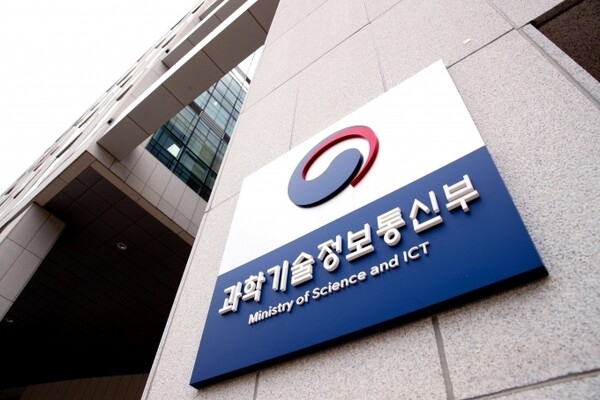
South Korea's Ministry of Science and ICT said on Thursday it held the ninth Korea-France Joint Committee on Science and Technology with France's Ministry of Higher Education, Research and Space (MESRE) at the National Science and Technology Advisory Council in Seoul.
The joint committee is a regular consultative body run to share science and technology policy and identify cooperation tasks between the two countries based on a Korea-France science and technology cooperation agreement signed in 1981. The ninth meeting was held to mark the 140th anniversary of diplomatic ties and the French president's visit to South Korea.
Science and ICT Minister Bae Kyung-hoon (배경훈), also deputy prime minister, and Phillippe Baptiste, minister of higher education, research and space, reaffirmed that South Korea and France are key partners in major strategic core technology fields such as artificial intelligence (AI) and quantum.
Major South Korean research institutions including the Institute for Basic Science (IBS), Korea Advanced Institute of Science and Technology (KAIST), Seoul National University and Korea University signed memorandums of understanding with France's largest national research institution, the National Centre for Scientific Research (CNRS), and agreed to expand research cooperation and exchanges.
Kang Sang-wook (강상욱), director general for planning and coordination at the ministry, and Jean-Luc MOULLE served as chief representatives for the joint committee and discussed detailed cooperation measures. The two sides reviewed major science and technology policies and cooperation achievements to date. They shared the results of exchanges since 2018 between South Korea's science and engineering specialisation universities programme (K-STAR) and France's INSA Group, and agreed to expand the scope to cooperation among universities across France to lay the groundwork for science and technology education cooperation in Europe.
The Innopolis Foundation and France's SATT Network reviewed the status of cooperation on commercialising deep-tech technologies. They agreed to expand cooperation to build an innovation ecosystem, including identifying and matching corporate demand for proof-of-concept, linking to investment and promoting international joint research.
The two sides also discussed ways to expand cooperation in key strategic science and technology fields. They shared each country's main AI strategies, and the Korea AI Safety Institute proposed cooperation measures such as building a policy dialogue channel with France's National Institute for Research in Digital Science and Technology (INRIA) and exchanges of research personnel.
In quantum, KAIST and French quantum computing company Quandela agreed to strengthen cooperation on quantum hardware manufacturing and building supply chains for materials, parts and equipment using KAIST's national quantum fab infrastructure, based on three years of cooperation in quantum technology. Quandela agreed to set up an international cooperation centre called the Quandela Hub at KAIST from 2026 as part of its entry into South Korea, and to jointly 추진 education, research and industry-academia cooperation projects.
In theoretical physics, the two sides discussed cooperation measures to secure global leadership in physics. They agreed to strengthen the partnership between the Asia Pacific Center for Theoretical Physics (APCTP) and CNRS and to work together on multilateral research cooperation across physics.
Bae said the joint committee served as a chance to elevate the science and technology partnership between South Korea and France to a higher level in line with the 140th anniversary of diplomatic ties and the French president's visit to South Korea. He said South Korea will closely align with France in key strategic science and technology fields such as AI and quantum to secure leadership together in an era of global technology hegemony.
 Jin-ho Lee
jhlee26@d-today.co.kr
Jin-ho Lee
jhlee26@d-today.co.kr