
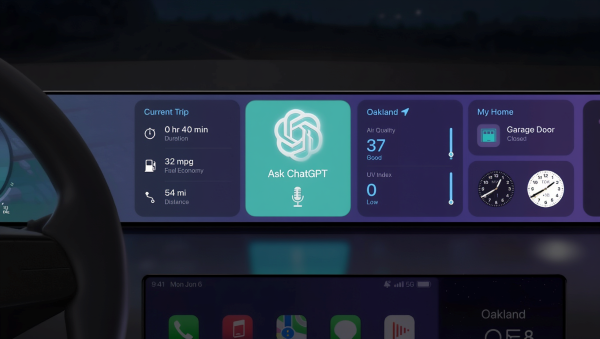
After Apple rolled out iOS 26.4, users can launch a dedicated ChatGPT app in CarPlay and talk by voice, but reactions have not been as strong as expected.
TechRadar reported on April 2 that users who install iOS 26.4 can download the ChatGPT app on an iPhone and then see a dedicated icon on the CarPlay screen. Once launched, users can continue voice-based conversations, and past chat history is also shown. Because of Apple’s safety rules, it does not support typing text directly or reading long answers on the screen.
That means ChatGPT on CarPlay appears to be designed to minimize visual manipulation while driving. Users have to focus on asking questions by voice and listening to responses, and the kind of use that involves looking at the screen for extended periods to check answers, as on a smartphone, is effectively restricted.
The CarPlay ChatGPT screen is a simple layout with only a “listening” indicator icon, a mute button and an end-conversation button. It is effectively the smartphone app’s voice mode moved onto the vehicle display. It is seen as enabling existing ChatGPT voice features to run within CarPlay rather than offering a separate, advanced in-car interface.
There are also significant functional limits. It does not support a wake word, so the app must be launched manually each time. It also does not offer functions such as controlling an iPhone or changing vehicle settings like Siri or other chatbots. For that reason, some assessments say it is closer to a separate conversational app for use in a car than a voice assistant for vehicles.
The key factors for usefulness while driving are instant invocation and device control, and the current CarPlay ChatGPT shows limits on both. Users have to tap the app to start it, and it is not structured to connect directly with vehicle or smartphone functions even after a conversation. As a result, it has symbolic value in that “ChatGPT can be used in a car,” but it also leaves an impression that its practicality is still limited to the point of replacing existing voice assistants.
Apple first included third-party voice-controlled artificial intelligence chatbots in CarPlay in the iOS 26.4 public beta in February. Unlike built-in assistants such as Mercedes-Benz’s “Hey Mercedes!” and Renault’s “Reno,” it opened a way to use chatbots such as ChatGPT, Google’s Gemini and Claude in CarPlay.
Still, the update is meaningful in that it shows CarPlay expanding in the direction of bringing various external AI services into the in-vehicle environment. As it remains closer to an early stage that shows the possibility of deploying general-purpose AI chatbots in vehicles, additional feature improvements appear needed before it becomes a service that changes the actual driver experience.
 Yoonseo Lee
yslee@d-today.co.kr
Yoonseo Lee
yslee@d-today.co.kr