
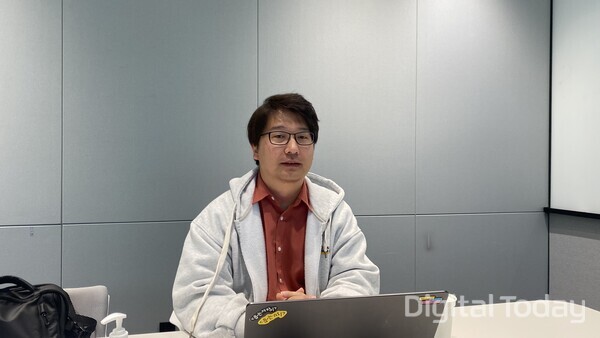
[Digital Today reporter Seul-gi Son] "We inject personas into agents, build the background knowledge and skills they will use, and design the workflow. That is how individuals run agent teams these days."
Hwang Min-ho (황민호), a developer with 17 years of experience who works at a major IT company in Pangyo, is an AI power user. At his company, he works with the title of senior. He tries the latest AI technology firsthand and regularly shares the results on social media and developer communities. Examples include 'Hanes 100', which contains 100 agent use scenarios, and a Claude Code guidebook that drew 700 GitHub stars within days of its release. He also writes an SF web novel and then creates a webtoon adaptation, and sometimes builds an on-the-spot tool for drawing with emoticons. Right after the government announced the introduction of a markdown format, he also posted a Hangul conversion tool.
His development career began in search services. For 15 years he handled advertising, search and open source. When ChatGPT appeared, he felt it was "a fun friend." That was because it headed in the same direction as search. He recalled, "AI, in the end, started from quickly finding what I need. The direction was the same as search."
As he tested it, he began posting reviews on an internal community. The response was good. His habit of researching and sharing overseas trends naturally carried over into the AI field. More opportunities followed. He also took on development of AI solutions and services, and that led to supporting companywide AX in an AI-native organisation. He now works as a forward-deployed engineer, circulating among multiple organisations and helping AI work transitions on site.
Changes in development work have been dramatic. Hwang said, "Before ChatGPT, it was a three-month project. After ChatGPT came out, it shrank to one month, and as tools like Cursor and Claude Code came out, it changed to two weeks." More recently, he said that by applying harness engineering, "we build a minimum viable product in 1 hour, and deployment goes out in two days."
How he works with non-developers has also changed. In a one-hour meeting, he sometimes produces a prototype that reflects ideas in real time. He said, "While the people in charge explain the task, I have several AI agents work simultaneously on my laptop. Toward the end of the meeting, I turn the screen and ask, 'Is this the system you meant?' and they are quite surprised."
The personal sphere is no exception. He said, "Writing a post on overseas AI trends used to take about two hours including translation, then it became one hour. Recently, if there is a good link, I can add my personal opinion and publish in 10 minutes."
The key to cutting work time is harness engineering. It is a methodology for assigning personas to multiple agents and configuring background knowledge and skills, and Anthropic introduced the concept on its blog last November. Hwang compared it to a real estate contract. He said, "Before ChatGPT, I looked up real estate knowledge and went. When Cursor and Claude Code came out, I rode along with AI by my side. At the harness engineering stage, I make an agent that goes to the real estate office in my place and even signs the contract."
Harness has three elements: agents that work in place of people, skills that provide the knowledge and methodologies agents use, and orchestration that sets the order and rules for how agents cooperate. Hwang validated the methodology across 100 scenarios and released it as a Claude Code plugin. He said, "I worried before releasing it, but each one felt like a startup."
One example is a harness for writing an SF web novel. With a single-line request, "I'm going to write an SF novel," agents for character design, world-building and scientific consulting were automatically created. The agents first designed chapter outlines and foreshadowing and then began writing. The finished novel continued into a webtoon. A 12-page webtoon produced 360 generated images. Of those, a review agent judged 40 as below standard and redrew them on its own, and Hwang intervened directly in 20. He said, "It takes care of things I didn't even ask for."
He also stressed that handling AI agents well is separate from coding ability. Hwang said, "People think developers will be good at it, but in reality planners or team leaders are often better. Someone who has had experience assigning work to people also assigns work well to agents." He added, "Developers write one line to an agent. People who are good at it write five or six lines in a row, and their thinking and 고민 are embedded."
On concerns about developer jobs, he said, "It is important not to see AI as a replacement threat, but to use it as much as possible and build experiences that raise your capabilities." He said it should be taken as an opportunity for juniors and as a chance for seniors to abandon inertia. He said, "People who accept change and turn off the switch for old ways have an advantage."
 Seul-gi Son
sageson@d-today.co.kr
Seul-gi Son
sageson@d-today.co.kr