
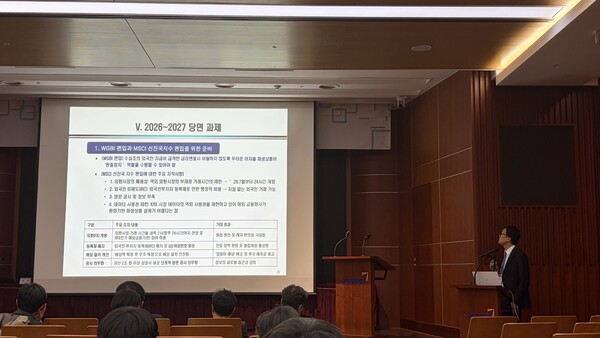
Yoon Sun-jung (윤선중), a professor at Dongguk University, presented structural limits in the domestic market and directions for regulatory improvements at a policy symposium held on April 2 at the Financial Investment Center in Yeouido, Seoul, titled '30th anniversary of the introduction of exchange-traded derivatives: achievements, issues, and preparing for the next 30 years.'
Yoon noted that Korea’s exchange-traded derivatives market grew rapidly after KOSPI200 futures were listed in 1996, and that the KOSPI200 options market once became the world’s largest by number of contracts traded.
He assessed that trading volume fell sharply after 2011 market-strengthening measures raised the trading multiplier to 500,000 won from 100,000 won, increased the basic deposit to 50 million won and introduced mandatory education for retail investors.
Yoon said the measures were meaningful in easing excessive speculative demand, but ultimately sharply reduced liquidity in Korea’s derivatives market.
He said overseas markets such as the Chicago Mercantile Exchange (CME) increased or maintained trading by diversifying product lines, while the Korean market failed to break out of a decline in volume.
He cited limits in the domestic market including an index bias centred on the KOSPI200, a limited lineup of interest-rate and commodity derivatives, conservative use by institutional investors and a concentration in ELS and DLS in the over-the-counter market.
He pointed to a balloon effect in which funds moved to overseas high-risk products or the crypto market while domestic investors were bound by strong pre-emptive regulation.
Yoon stressed the need to shift the regulatory paradigm from pre-emptive regulation to post-trade monitoring and strong sanctions.
“We need to widen the entrance to some extent, keep monitoring tight, and shift the regulatory paradigm through very strong penalties in case of violations,” he said.
He also proposed making it easier to allow listings for standardised products already listed overseas, and introducing detailed regulations tailored to market characteristics instead of uniform basic-deposit rules.
He also said the monitoring functions of self-regulatory bodies such as the Korea Exchange and the Korea Financial Investment Association should be strengthened and the cost of violations raised to balance autonomy and responsibility.
As tasks for this year and next, he proposed expanding interest-rate derivatives and improving infrastructure for managing currency and interest-rate risk to respond to a bigger inflow of foreign funds tied to the inclusion of the country in advanced-economy sovereign bond indexes.
He said risk-management tools should also be reinforced alongside 24-hour opening of the foreign exchange market, improvements to systems for foreign investment and expanded English-language disclosures.
Yoon also mentioned a trend in the United States to mandate central counterparty clearing (CCP) for repo and Treasury trading from July 2027.
He said Korea’s repo market should also review the need to introduce a CCP to block risk transmission in times of crisis, and that the shift from a CD rate-based framework to a risk-free benchmark rate (KOFR)-based framework should proceed faster.
“A healthy derivatives market is the surest milestone on the path to an advanced capital market,” Yoon said.
 Oh Sang-yup
yub@d-today.co.kr
Oh Sang-yup
yub@d-today.co.kr