
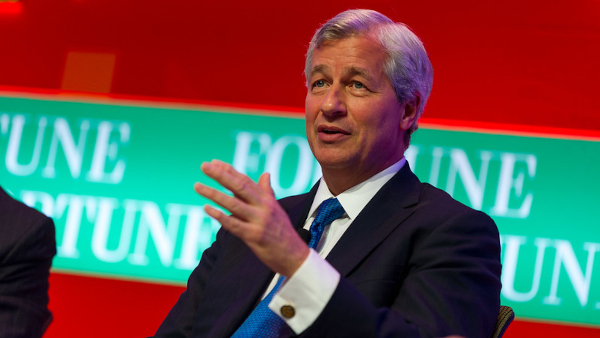
[DigitalToday reporter Yoonseo Lee] JPMorgan Chase Chief Executive Jamie Dimon (제이미 다이먼) mentioned the possibility of entering prediction markets.
On April 1 (local time), blockchain media outlet CoinDesk reported that Dimon told CBS, "One day we may be able to do that." He drew a line, though, saying it would not offer sports- or politics-related markets. "There are a lot of things we are not going to do," he said. "There are strict rules on insider information," he added.
A boom in prediction markets has recently continued in the cryptocurrency market. Goldman Sachs is also reported to be considering the possibility of participating in prediction markets. Goldman Sachs CEO David Solomon (데이비드 솔로몬) said on an earnings conference call in January, "Over the past two weeks I met directly with the management of two large prediction market companies and spoke with each for several hours." He added that dedicated staff at the firm are in contact with those companies and are reviewing related matters.
Prediction markets have grown quickly in recent months, intensifying competition. For a time, Polymarket and Kalshi were seen as the two main operators, but more recently Coinbase and Robinhood have also integrated prediction market trading into their services, increasing access for retail investors.
The leading players are also getting bigger. Polymarket secured partnerships and investments, including ties with Intercontinental Exchange, the parent company of the New York Stock Exchange. The market values Polymarket at $20 billion, about 30.45 trillion won. Kalshi received a valuation of $22 billion, about 33.5 trillion won, after an investment round led by Coatue Management.
The two platforms operate differently. Polymarket records trades on blockchain networks such as Polygon and settles through smart contracts. Users deposit stablecoins to bet on outcomes and are paid automatically based on confirmed results. Kalshi, by contrast, does not use blockchain and runs event contracts through centralised order matching and settlement under a regulatory framework.
It has not yet been decided whether JPMorgan or Goldman Sachs will choose a blockchain-based approach in the future or use existing financial infrastructure. The legal status of prediction markets in the United States is also still being organised as debates continue over event types and contract classification. Earlier this month, the U.S. Commodity Futures Trading Commission took steps toward establishing a regulatory framework for prediction markets.
As major Wall Street financial firms also begin to show interest in prediction markets, the sector is moving beyond the experimental stage of crypto platforms and broadening its points of contact with mainstream finance. Still, with business models, technical approaches and regulatory interpretations not yet fully settled, whether firms enter and what services they offer are likely to vary depending on changes in the regulatory environment.
 Yoonseo Lee
yslee@d-today.co.kr
Yoonseo Lee
yslee@d-today.co.kr