
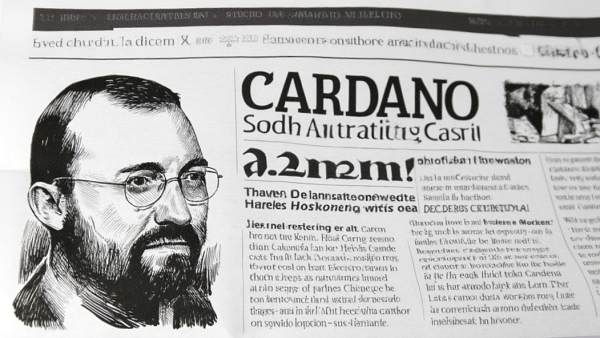
Charles Hoskinson (찰스 호스킨슨), founder of Cardano (ADA), argued that even if the U.S. Clarity Act is enacted, its real impact could be delayed for years. He said the process of the U.S. Securities and Exchange Commission (SEC) and the Commodity Futures Trading Commission (CFTC) drafting detailed rules could be lengthy.
On April 1, local time, blockchain outlet The Crypto Basic reported that he said the process after legislation, from rulemaking to enforcement, may not immediately deliver the “clarity” the industry expects. The Clarity Act passed the U.S. House of Representatives in July 2025 and sets out criteria for whether digital assets are treated as securities under SEC jurisdiction or commodities under CFTC jurisdiction.
Hoskinson then claimed Coinbase is opposing parts of the bill and slowing legislative progress. He said it is placing more emphasis on defending stablecoin-related revenue than on regulatory clarity for the industry as a whole. He said Coinbase is citing consumers’ access to yield, but is in fact more sensitive about protecting income generated from stablecoin balances.
A revised version from the Senate Banking Committee is reported to include provisions to limit stablecoin yield and expand reporting obligations for DeFi platforms. In subsequent negotiations, a compromise was included that effectively bans passive yield payments on stablecoin balances, but Coinbase opposed it and cited concerns including monitoring of DeFi activity, limits on tokenised stocks and restrictions on stablecoin rewards. Hoskinson said he sees stablecoin yield as the core issue among these.
Hoskinson said stablecoins are one of Coinbase’s main revenue sources. He said Coinbase generates significant income from its stablecoin business through ties to the USDC ecosystem, and it is estimated that in 2025, USDC reserve-management income contributed substantially to performance, with Coinbase’s share reaching about $1.35 billion. That is interpreted as meaning Coinbase is concerned about the impact on its business model.
He also said the bill could create room to classify many tokens in practice as securities and could weaken protections for DeFi developers. He said it could impose excessive legal liability on developers, extending even to how open-source code is used. He said if such a framework is закреплено in law, it would be difficult to reverse and could last for decades.
Meanwhile, Ripple CEO Brad Garlinghouse (브래드 갈링하우스) is arguing that the current bill can be used as it is. Hoskinson countered that XRP has already received a “free pass” and that the same bill could be a risk for new projects. The Clarity Act is set to continue for further discussion in the Senate.
 Yoonseo Lee
yslee@d-today.co.kr
Yoonseo Lee
yslee@d-today.co.kr