
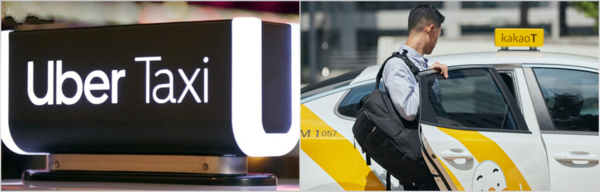
[Digital Today reporter Seok Dae-geon] Both Uber and Kakao Mobility are drawing a line, for now, over reports that the global mobility leader is reviewing a takeover of management control of Kakao Mobility, South Korea’s largest platform.
Uber was reported to have conveyed its intent to the major shareholder side and to be conducting due diligence to acquire management control through a purchase of Kakao Mobility shares.
A Kakao Mobility official said the company is not the party selling the stake cited in the acquisition-related article and officially has no knowledge. A representative of Uber Taxi, which runs the company’s local business, also said there was no official corporate position and that it was being checked.
Kakao Mobility’s 2025 business report shows its top shareholder Kakao holds 57.2 percent. KHAKI HOLDINGS of TPG Capital holds 14.29 percent, and KILOMETER HOLDINGS of the Carlyle Group holds 6.17 percent, followed by other financial investors. LG also holds a minority stake of 2.46 percent and Google holds 1.52 percent.
The industry is focusing on differences in the two companies’ business direction. Uber Taxi is concentrating on expanding its share of the domestic taxi-hailing market, while Kakao Mobility is expanding its platform across lifestyle services such as logistics, delivery, car washing and designated-driver services, based on more than 90 percent share of the taxi market. That includes widening its scope this year into next-generation technology areas such as physical AI as a priority business.
Kakao Mobility’s results are on an upward trend. It posted 739.3 billion won in revenue and 115.5 billion won in operating profit last year, extending operating profit growth for a third consecutive year. Its operating margin improved 1.8 percentage points from a year earlier to 15.6 percent, and net profit rose 78 percent to 51.4 billion won. Accumulated losses fell by 84.4 billion won over two years, putting financial soundness on a path to recovery.
Uber is accelerating the expansion of autonomous driving taxis in global markets. It recently moved to acquire Germany’s Blacklane, and in Croatia it is preparing Europe’s first robotaxi with Pony.ai. In Tokyo, Japan, it has also flagged a robotaxi pilot service by the end of 2026 with Nissan and Wayve.
Uber has said it will proceed on whether to pursue autonomous-driving business in South Korea in line with progress in building related legal and institutional frameworks, taking a direction that contrasts with its global business. Uber Taxi, its domestic business, is also working to raise its share of the taxi-hailing market. At a press briefing held last year, Uber Taxi head Jinwoo Song (송진우) said, "Until we grow to a certain extent in the Korean market, we will focus on the core."
 Seok Dae-geon
d2dg@d-today.co.kr
Seok Dae-geon
d2dg@d-today.co.kr