
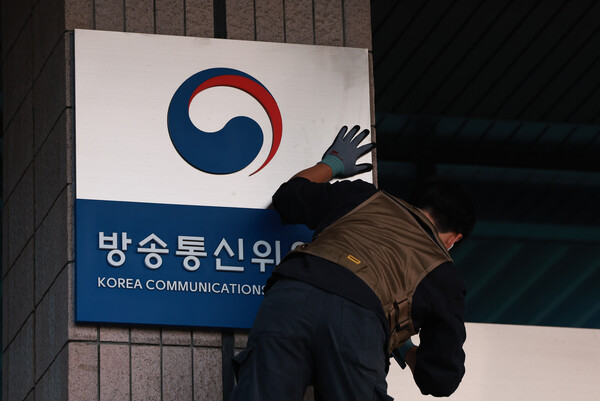
The formation of the Broadcast Media Communications Commission again failed to move forward.
An agenda item to recommend commission members was not included in the National Assembly plenary session schedule on Monday. The session, which began at 3 p.m., tabled nine items including a motion to approve the arrest of lawmaker Kang Sun-woo (강선우), judicial-related amendments such as to the Commercial Act and the Criminal Act, and a special bill to establish the Jeonnam-Gwangju Integrated Special City. With the nominations omitted, the commission’s formation was pushed to the March extraordinary session.
The commission launched on Oct. 1 last year, but it took nearly 80 days to appoint its chair. Delays in the National Assembly’s recommendation process have since left it operating in a limited capacity for five months. Under the current law establishing the body, it is a seven-member council, with three standing members and four non-standing members, and it can vote only if at least four members are present. It currently has only two members, including Chair Kim Jong-cheol (김종철), nominated by the president, and non-standing member Ryu Shin-hwan (류신환), making it impossible to deliberate and vote on major agenda items.
Cheon Young-sik (천영식), head of Pen & Mike, is reported to have been tapped as the People Power Party’s candidate for a standing member post. The National Union of Mediaworkers said the head of what it called a "media outlet that defends insurrection" cannot be appointed as a standing member, urging the National Assembly to act. That has prompted talk that even if the recommendation motion is placed on the plenary agenda, it cannot rule out the possibility of defeat. The Democratic Party, meanwhile, picked Go Min-su (고민수), a professor at Gangneung-Wonju National University, as its candidate for a standing member on the 23rd of last month, and Yoon Seong-ok (윤성옥), a professor at Kyonggi University, as its candidate for a non-standing member on the 28th of the same month.
The longer the delay drags on, the clearer the limits of a consensus-based body are becoming.
The Democratic Party designed the commission as a seven-member consensus body, mindful of criticism that the former Korea Communications Commission effectively operated like a sole-leader system, but political conflict between the ruling and opposition parties is holding up the process from the formation stage. Even as the Feb. 27 deadline under the amended Broadcasting Act for forming programming committees at broadcasters nears, the commission has been unable to draw up even related rules. Once it is normalised, a backlog of pending issues will be waiting, including broadcast licence renewals, a review of approval for a change in YTN’s largest shareholder, and platform fines.
 Seulgi Son
sageson@d-today.co.kr
Seulgi Son
sageson@d-today.co.kr