
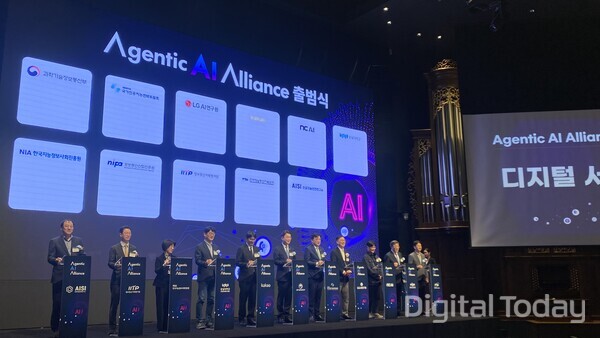
The government is teaming up with about 260 companies and institutions to join the race for leadership in the AI agent ecosystem.
The Ministry of Science and ICT held the launch ceremony of the "Agentic AI Alliance" at L Tower in Seoul on Tuesday and officially activated four working groups covering industry, technology, ecosystem, and safety and trust.
Ryu Je-myung (류제명), the ministry's second vice minister, said AI competition goes beyond a race in technology to a contest for control of the ecosystem. He said the government would boost the global competitiveness of Korean companies and ensure agentic AI leads to changes people can feel in daily life.
Agentic AI refers to AI that goes beyond question-and-answer functions to make decisions and act on its own. Global big tech companies such as OpenAI, Google and Microsoft have already moved to seize the agent ecosystem, and South Korea is responding through public-private cooperation.
Cho Joon-hee (조준희), head of the industry AX and ecosystem subcommittee at the National AI Strategy Committee, said the time for choosing between reliance on foreign technology and building an independent ecosystem is over. He stressed it was time to act.
The alliance will be run under private-sector leadership. The government will play a supporting role through regulatory improvements, policy coordination and support for demonstrations.
The operational direction for each of the four working groups is as follows. The industry group, led by Dong-hoon Shin, head of the NC AI AX Tech Center, will focus on matching demand companies with suppliers. Geon-su Kim, head of NC AI, who presented on behalf of Shin, cited three key challenges in the field: unclear accountability, uncertainty over standards and interoperability, and the lack of a venue linking demand and supply. The group plans to hold an April kickoff, form small groups by industry in June, and aim for visible results by December.
The technology working group, led by Gi-jeong Jeon of LG AI Research's service development division, will focus on securing interoperability based on existing protocols such as Model Context Protocol (MCP) and agent-to-agent (A2A), and on developing a domestic agent coding benchmark. Jeon said LG AI Research is already operating a multi-agent development environment in which frontend, backend and QA agents collaborate within a Slack channel.
In connection with this, Byeong-su Baek (백병수), director-general for digital talent development at the ministry, said the idea is not to create new protocols such as MCP but to add compliance on top of what already exists. He said China is attempting to develop its own protocols, but it would not be easy for South Korea to realistically follow suit.
Se-woong Kim (김세웅), a Kakao vice president and head of the ecosystem working group, proposed tasks including an orchestration structure and marketplace design to connect individual agent services. Kim distinguished between AI agents as individual vertical services and agentic AI as a higher layer that connects and orchestrates them.
The safety and trust working group will be led by Dae-seon Choi (최대선), head of Soongsil University's AI Safety Research Center. It aims to build a safety evaluation system tailored to the characteristics of agents. Choi said an agent can hand over a user's authority to another agent, which then calls another service, meaning a single error can trigger a chain reaction. He stressed that if the safety and trust group fails, the entire alliance fails.
 Seulgi Son
sageson@d-today.co.kr
Seulgi Son
sageson@d-today.co.kr