
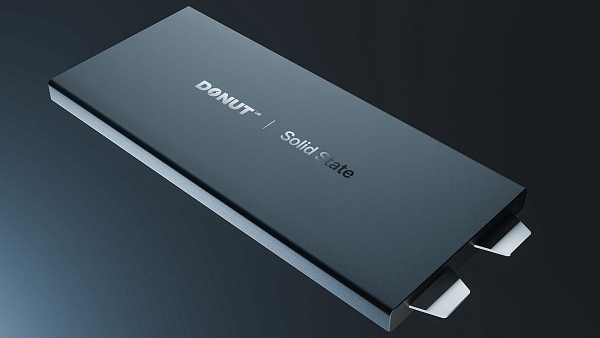
Finnish startup Donut Lab has released the first independent test results for its controversial solid-state battery. The test was conducted by Finland's state-owned VTT Technical Research Centre. The report verified at least the ultra-fast charging performance. It also highlighted technical constraints, underlining that hurdles remain before solid-state batteries can be commercialised.
A VTT report (VTT-CR-00092-26) cited by electric vehicle outlet Eletric on Feb. 23 (local time) said Donut Lab's 26Ah single cell reached 0 to 80 percent in 4 minutes 30 seconds at an 11C (286A) charging rate. Charging was conducted using a constant-current, constant-voltage (CC-CV) method up to 4.3V. Before and after charging, capacity was verified by discharging at 1C down to 2.7V.
The temperature rise was clear. Under 11C charging using two heat sinks, the surface temperature rose to 63 degrees Celsius from 26.5 degrees. Under 5C charging, it measured 61.5 degrees with a single heat sink and 47 degrees with two heat sinks.
The issue is thermal management. In the 11C test with only a single heat sink, the test was temporarily halted when the cell surface temperature reached the 90-degree safety limit. After about 4 minutes of cooling and improving contact with the heat sink, the test resumed. This shows that, contrary to Donut Lab's promotion that "active cooling is not necessary", some level of thermal engineering is essential in extreme high-speed charging conditions.
It is also disappointing that the report focused only on verifying charging speed. Key claims that have drawn the biggest controversy in the industry, including 400Wh/kg energy density, a 100,000-charge lifespan, maintaining 99 percent capacity at minus 30 degrees, stability above 100 degrees and cost parity with lithium-ion batteries, have not yet undergone independent verification.
Donut Lab unveiled the battery at CES in January, but it fuelled doubts by making the announcement without a live demonstration or patent disclosure. Yang Hongxin (양홍신), chairman of Chinese battery maker Svolt Energy, said "all parameters are contradictory" and effectively raised the possibility of fraud. In response, Donut Lab CEO Marko Lehtimaki (마르코 레티마키) pushed back, saying he would stake his reputation on the technology and that he would release an additional VTT report within weeks.
The industry is maintaining a cautious stance even as it assesses the results as a "meaningful first step". Charging in 4.5 minutes at 11C is clearly impressive, but the true competitiveness of solid-state batteries is determined by energy density, lifespan and cost structure. Attention is focused on whether Donut Lab can resolve the remaining questions with follow-up data.
Global competition in solid-state batteries is also intense. China's BYD and CATL are aiming for small-scale production around 2027, while Toyota plans mass production in 2030. Geely also plans to unveil its first solid-state battery pack this year. However, no company has said it has a commercial-stage cell that meets all the specifications Donut Lab claims at the same time.
 Jinju Hong
hongjj@d-today.co.kr
Jinju Hong
hongjj@d-today.co.kr