
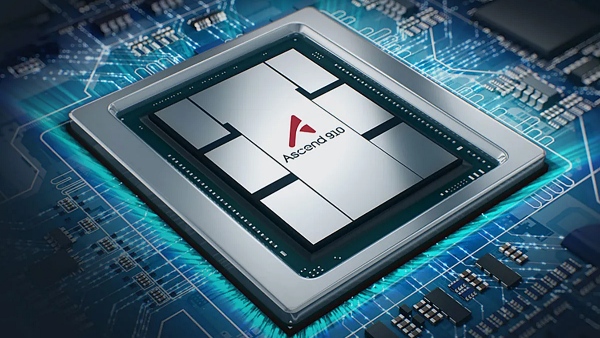
Shenzhen, a technology hub in southern China, is moving to ramp up its AI self-reliance strategy as it begins full-scale operation of large computing infrastructure based on Huawei's domestically made artificial intelligence chips.
On March 31, the Hong Kong-based South China Morning Post reported that Shenzhen has started operating an intelligent computing cluster with 10,000 cards using Huawei Technologies' Ascend 910C chips. It is seen as the first large-scale case in China built on domestically produced chips.
The cluster's computing performance is about 11,000 petaflops. Shenzhen built a first-stage cluster with 3,000 petaflops last year and has operated it fully booked. With the second-stage expansion, total computing capacity has risen to about 14,000 petaflops. Local media outlet Shenzhen Special Zone Daily reported that about 50 institutions joined the new cluster and signed contracts for computing resources, with overall bookings at 92 percent.
The high utilisation rate underscores surging AI demand centred on Shenzhen. As AI startups, robotics companies and research institutes flock to the city, competition to secure computing resources has intensified, according to an analysis. Zhang Runcheng (장룬청), vice president of robotics startup X Square Robot, said, "As both the scale and quality of computing power improve, Shenzhen is emerging as a national AI hub."
A gap in hardware competitiveness still remains with global leaders. DeepSeek analysis estimates Huawei's Ascend 910C at about 60 percent of Nvidia's H100 performance. Even so, Chinese companies are expecting next-generation chips to narrow the gap quickly.
Shifts are also being detected on the demand side. Reuters reported that major big tech companies including ByteDance and Alibaba are considering adopting Huawei's next-generation AI processor, Ascend 950PR. The chip is being watched for whether improved software ecosystem compatibility and faster response speeds can disrupt a market structure long centred on Nvidia's CUDA. Huawei is reportedly preparing to mass-produce the 950PR and supply it at a level of hundreds of thousands of units within the year.
The cluster launch also aligns with Shenzhen's long-term AI infrastructure strategy. With a goal of becoming a global AI computing hub by 2028, the Shenzhen city government is moving to expand server production and strengthen supply chains for core components such as chips, storage and optical modules. It has also presented a plan to raise the city's real-time AI computing capacity to more than 80,000 petaflops by 2026.
The moves are also a microcosm of the computing power race underway across China. The China Academy of Information and Communications Technology said that as of mid-2025 China's total computing power was about 962,000 petaflops, up 73 percent from a year earlier and accounting for 21 percent of the global share. The Shenzhen project carries symbolic significance because it has brought domestically produced chip-based infrastructure into a practical commercial stage.
The key variables are whether the high booking rate can translate into results for AI services and the robotics industry, and how much Huawei's next-generation chips can narrow the global gap in performance and software ecosystems. Shenzhen's experiment is becoming a testbed for gauging the broader Chinese AI industry's prospects for self-reliance, beyond a simple city project.
 Jinju Hong
hongjj@d-today.co.kr
Jinju Hong
hongjj@d-today.co.kr