
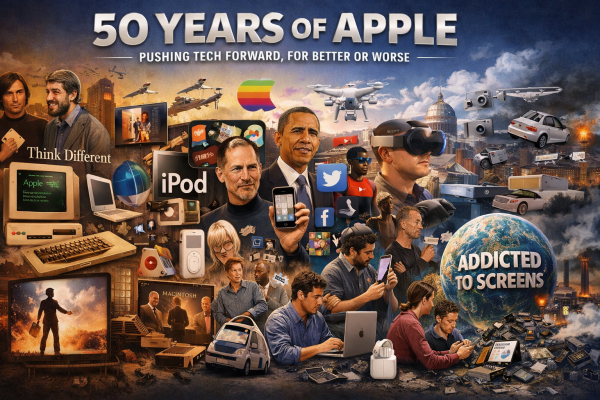
[DigitalToday reporter Jinju Hong] Apple has accelerated technology transitions over the past 50 years not only in how it releases new products but also in how it boldly removes things.
In related coverage, the IT media outlet Engadget on March 29 (local time) assessed that Apple has led the PC, smartphone and wearable eras while pushing out familiar elements, from floppy disks to headphone jacks, reshaping the direction of the broader industry itself.
Apple's strategy largely follows a repeated pattern. When a new change is announced, user inconvenience and backlash follow at first, but over time competitors move in the same direction. The outlet assessed this as a case of "reading where technology is headed and bringing forward an inevitable transition."
A leading example is the iMac G3 introduced in 1998. Apple removed the floppy disk drive, then widely used in PCs, and adopted a USB-centered structure. The design, which emphasized internet connectivity, was radical at the time, but later aligned with the market's direction as USB storage devices and cloud environments spread.
Apple is also marked by a self-cannibalization strategy. The iPod, which had dominated the music player market, gradually lost its role after the iPhone appeared in 2007. Soon after launching the iPhone, Apple released the touch-based iPod touch, accelerating the shift of music consumption to smartphones, and eventually discontinued the iPod classic in 2014, the nano and shuffle in 2017, and the iPod touch in May 2022.
The change was also clear in how users input commands. In a mobile phone market centered on physical keyboards, the iPhone put a capacitive touchscreen and a software keyboard front and center. There were early assessments that it was inconvenient, but the scalability of software-based input drew attention as screen enlargement, predictive input and multilingual support developed, and it became an industry standard.
In laptops, slim design drove another round of removals. The MacBook Air in 2008 was the first case to remove an internal optical drive. There was inconvenience at the time because users had to rely on an external drive or network sharing functions, but optical disc drives quickly disappeared as cloud and streaming became common.
A similar flow continued in the web ecosystem. Apple refused to support Adobe Flash on the iPhone and iPad, and Steve Jobs pointed to security problems and inefficiency in touch environments in an open letter, 'Thoughts on Flash'. The decision prompted developers to move to open standards such as HTML5, and Flash officially ended in 2020.
The most contentious change was the removal of the 3.5mm headphone jack in the iPhone 7 in 2016. Apple described it as "courage" and emphasized a shift to wireless, and it released AirPods around the same time, leading market adoption. There was significant inconvenience at first, including the need to use adapters, but wireless earphones later became popular quickly.
The MacBook Pro (2016), unveiled the same year, also removed many legacy ports and was reorganized around USB-C, sparking controversy over "dongle hell". Still, the decision helped expand the USB-C ecosystem quickly, and Apple later adjusted its strategy by reintroducing some ports.
In this way, Apple's history has been a series of decisions not only to add innovation but also to remove things. Each move generated debate, but its influence is clear in that the broader industry ultimately moved in that direction, as with USB, touch interfaces, the cloud and wireless audio. At the same time, some decisions were reversed, leaving it a key point of interest for the industry to gauge whether Apple's next removal will become a market standard or be modified.
 Jinju Hong
hongjj@d-today.co.kr
Jinju Hong
hongjj@d-today.co.kr