
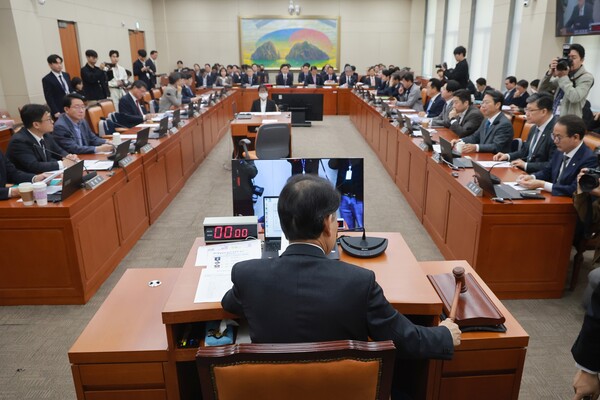
At a plenary meeting of the National Assembly's Political Affairs Committee on March 31, lawmakers from both the ruling and opposition parties unusually spoke with one voice to pressure the Financial Services Commission over delays in proposing the government's Digital Assets Basic Act.
Min Byeong-deok (민병덕), a Democratic Party lawmaker, took aim at FSC Vice Chairman Kwon Dae-young (권대영), saying he was certain there was no government bill and that was why it had not been submitted so far. He said more than a year has passed since the parties each put forward their own bills. He urged starting discussions by putting the matter directly on the legislative subcommittee agenda rather than waiting indefinitely for the government proposal.
Criticism was also sharp within the opposition. Kim Sang-hoon (김상훈), head of the People Power Party's digital assets task force, said the industry expects the government to help warm up the digital market and voiced frustration at the delay.
He pointed to a provision limiting post-ownership stakes of major shareholders of digital asset exchanges as the cause of the delay. He said a stake-limitation item, without precedent globally, was suddenly inserted into talks that had originally focused on debating the entity responsible for issuing stablecoins, and agreement between the parties began to unravel.
The government and ruling party are currently considering a plan to cap major shareholder stakes in exchanges at 20 percent, while exceptionally allowing up to 34 percent. The People Power Party opposes the ownership cap itself, and there is also considerable opposition within the Democratic Party on grounds it could hinder industrial innovation and raise constitutional issues.
The Korea Legislation Research Institute also said in a report on March 26 that restricting share ownership itself could infringe constitutional property rights and the freedom of corporate activity, pointing to a possible violation of the principle against excessive restrictions.
The FSC initially set the first quarter of this year as its target to wrap up the process and planned to finalise a deal after party-government consultations earlier this month.
But the party-government consultations were postponed indefinitely as it focused its capacity on responding to a Middle East-driven financial crisis. In political circles, there are forecasts that passage in the first half of the year is effectively difficult and that, with constitutional disputes and party differences intertwined, passage in a National Assembly plenary session within the year is uncertain.
Asked about the matter, Kwon gave only a brief reply of "OK" and was unable to give a specific timing for submitting the bill.
 Oh Sang-yup
yub@d-today.co.kr
Oh Sang-yup
yub@d-today.co.kr