
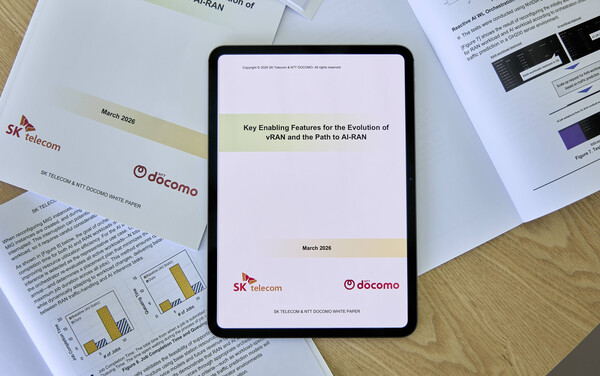
SK Telecom said on Monday it has jointly published a white paper with Japanese mobile operator NTT Docomo covering key technical requirements and development directions for the evolution of virtualised base stations (vRAN) and the implementation of AI-based radio access networks (AI-RAN).
The white paper was written based on the two companies' experience in building and operating mobile networks. It analyses, from a mobile operator perspective, the advancement and development potential of vRAN and AI-RAN, related technical requirements, key implementation technologies and the effects of adoption.
The two companies presented three core technical requirements needed to maximise the effectiveness of vRAN and AI-RAN in the white paper.
First, it stressed clear separation of hardware and software to accelerate the introduction of new functions. By functionally separating base station control software from specific hardware or virtualisation platforms, software can be deployed independently of the infrastructure.
It also set out the need for resource pooling technology to build flexible infrastructure and improve resource utilisation. Using the technology can expand base station capacity and improve power efficiency while maintaining service quality. It can also enable flexible network operations and help strengthen mobile operators' competitiveness.
Implementing AI computing functions using virtualised base station systems was also cited as a key task. In an xPU (x Processing Unit)-based vRAN structure, orchestration technology that integrates management of AI and communications resources can provide AI computing functions while maintaining communications service quality. This can develop vRAN into an integrated AI platform that provides communications and AI services at the same time, namely AI-RAN.
Earlier this month, SKT unveiled proof-of-concept results for resource pooling technology and orchestration technology within xPU-based vRAN at MWC 2026.
SKT and NTT Docomo signed a research cooperation agreement in November 2022 on next-generation communications infrastructure technologies for 5G evolution and 6G. In February 2023, they jointly published a white paper on mobile network power-saving technologies and 6G requirements. In February 2024, they released a white paper covering key considerations for building and operating vRAN, including selecting L1 accelerators to meet network design requirements.
Tak-ki Ryu (류탁기), head of network technology at SKT, said, "This white paper presents key elements needed to maximise the benefits of adopting virtualised base stations and to evolve toward autonomous networks from a mobile operator perspective." He added, "We hope the outcomes derived through cooperation with NTT Docomo contribute to the development of global next-generation mobile networks and the expansion of the ecosystem."
 Jin-ho Lee
jhlee26@d-today.co.kr
Jin-ho Lee
jhlee26@d-today.co.kr