
LG Uplus is accelerating a shift in its business structure by making "physical AI" and "AI data centres (DC)" its two main pillars. It is moving in earnest to evolve into a comprehensive AI company based on data gained from its telecommunications business.
The company has recently formalised a strategy to expand its voice AI capabilities built around its AI agent ixi-O. At MWC26 held earlier this month in Barcelona, Spain, it unveiled its move toward Ambient AI that connects various devices and spaces with a focus on voice.
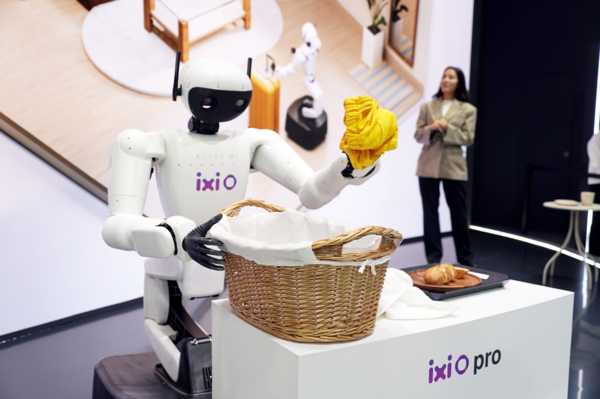
Through its exhibition hall, it demonstrated a humanoid robot that combines robots, a representative form of physical AI, with an AI agent. It also presented a future vision of turning telecommunications infrastructure into an AI execution platform. LG Uplus in particular stressed it will transform its telecom network from a simple connectivity infrastructure into a platform on which AI runs and services are executed.
The starting point for this strategy is ixi-O. LG Uplus has advanced voice-based AI services such as understanding call context, detecting voice phishing and real-time information search. The company explains it is developing ixi-O beyond executing simple voice commands into an AI agent that identifies context and emotions in calls and responds proactively by judging risk and necessity, suggesting actions and executing them.
LG Uplus in particular is seeking to leap into a global AI company based on voice data. At an MWC26 press briefing, LG Uplus CEO Beom-sik Hong (홍범식) said, "Our aim is to become a company that leads the solutionisation of telecommunications and AI transformation technologies."
Another focus is AIDC. LG Uplus recently highlighted AIDC business results at a regular shareholders meeting and presented it as a key growth engine going forward. At the meeting, it approved a proposal to add "data centre design, operation and construction-related operations" to its articles of incorporation and will push in earnest to expand new data-centre-centred businesses.
The industry sees significant synergy if physical AI and AIDC are combined. That is because a virtuous cycle is possible in which massive data generated from devices such as industrial robots are processed at AIDC and then linked back to services. In this process, network quality, latency and data-processing efficiency are cited as factors that will determine service competitiveness. It is a point where telecom operators' accumulated infrastructure operation capabilities can be used as they are.
In particular, voice call data held by telecom operators is a point of differentiation. An industry official said, "The reason the telecom business can show advantages in AI is that the voice data from calls is inexhaustible," adding, "Since there are many samples and analysis cases, it will be possible to develop solutions that help more intuitive and accurate operation even when incorporating voice into physical AI in the future."
Still, challenges are substantial. Physical AI requires robots, devices, networks and cloud to be combined organically. Issues of personal data and AI ethics must also be considered. Competition with global big tech cannot be avoided.
A telecom industry official said, "If telecom operators have so far remained in the role of providing networks, they are now seeking to evolve into platforms where AI is executed," adding, "LG Uplus appears to be attempting that transition most actively based on voice data."
 Jin-ho Lee
jhlee26@d-today.co.kr
Jin-ho Lee
jhlee26@d-today.co.kr