
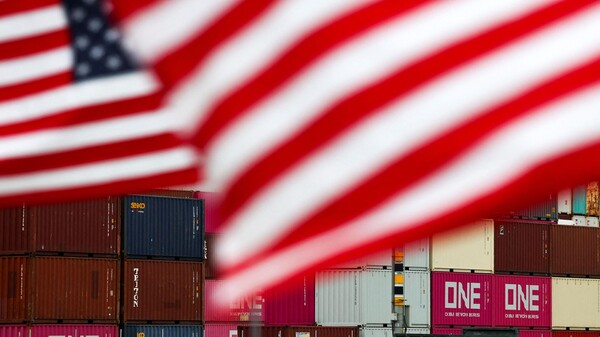
As a U.S.-China summit scheduled for May nears, South Korea's semiconductor industry is again coming under the influence of trade variables. In a recent report, the Peterson Institute for International Economics (PIIE) suggested the United States and China could seek a “win-win exit” to reduce mutual dependence in semiconductors and critical minerals. For South Korea's chip industry, which is setting record exports for a third straight month, the summit outcome is a juncture that could split the direction of the boom.
A summit between U.S. President Donald Trump and Chinese President Xi Jinping is scheduled for May 14-15. Trump was originally set to visit China in late March, but the trip was postponed as the war with Iran became prolonged. With the military burden of the Middle East war increasing, it became difficult to maintain a trade front with China at the same time, and this paradoxically acted as a factor that brought forward a phase of reconciliation with China.
Chad Bown (채드 바운), a senior fellow at PIIE, proposed in the report a mutually beneficial negotiating framework linking semiconductors and critical minerals. It is an idea to modify the General Agreement on Tariffs and Trade (GATT) approach so the two countries gradually reduce each other’s market dominance while limiting the risk of conflict.
According to the report, the U.S.-China semiconductor dispute in 2025 escalated to an unprecedented level. The United States expanded export controls on electronic design automation (EDA) software and then withdrew them, and it widened the scope of controls to include overseas subsidiaries of Chinese companies. This year, it imposed export taxes on artificial intelligence (AI) semiconductors from Nvidia and AMD.
China also responded by informally instructing its companies to stop buying U.S.-made AI chips and by requiring that 50 percent of semiconductor equipment be domestically produced. Although the two leaders agreed to a truce when they met at the APEC leaders’ meeting last October, tariff and export-control levels remain high compared with 2024. If the May summit becomes a venue to formalise a prior agreement, adjusting the scope of export controls could be included on the agenda.
◆ Equipment and materials procurement and sales channels to China carry risks on both sides
This phase of reconciliation between the United States and China is expected to have a direct impact on South Korea's semiconductor industry. The PIIE report analysed that the United States, Japan and Europe supply 89 percent of semiconductor equipment and more than 95 percent of EDA software. South Korea manufactures memory semiconductors on top of that supply chain and exports them to China.
According to the Korea Customs Service, semiconductor exports for March 1-20 totalled $18,657,000,000, up 163.9 percent from a year earlier, and exports to China over the same period rose 69 percent. By the Ministry of Trade, Industry and Energy's measure, total exports are also posting record highs for three straight months, at $65,850,000,000 in January and $67,450,000,000 in February. As dependence on China has increased, the scale of the impact from the summit outcome has also grown.
The key is the level of agreement after the U.S.-China summit. Even freezing export controls at the current level would be positive for the memory big 2, including Samsung Electronics and SK Hynix. With AI semiconductor demand currently driving the export boom, if the status quo holds without additional regulations, the flow of exports to China could continue for the time being.
If an agreement moves beyond a freeze and progresses toward easing, there is more room for exports to expand. If the United States lowers export taxes imposed on Nvidia and AMD AI chips, AI infrastructure investment in China would increase again, and this would directly lead to rising demand for memory semiconductors.
If China defers or eases the requirement for 50 percent localisation of semiconductor equipment, export routes to China for South Korean equipment and materials firms would also get breathing space. If the mutually beneficial negotiating framework proposed by the PIIE report is realised, South Korean companies could gain a windfall as both sides gradually adjust export controls.
The opposite scenario cannot be ruled out. If negotiations break down or enter a renewed escalation, both equipment and materials procurement routes and sales channels to China could be shaken at the same time. In particular, if the United States strengthens export controls to include semiconductor equipment, the production base of South Korean companies itself would come under the influence. PIIE said the United States, Japan and Europe supply 89 percent of semiconductor equipment. Because South Korea makes memory semiconductors with that equipment and sells them to China, expanding equipment export controls would directly hit manufacturing capabilities.
Earlier, in 2025, when the United States expanded export controls to include overseas subsidiaries of Chinese companies, exports of semiconductors from Netherlands-based Nexperia were blocked, disrupting the global supply chain. South Korean memory companies also operate production bases in China and are exposed to similar risks. An industry official said, "How far the scope of export controls is adjusted could determine the direction of memory performance."
 Daegeon Seok
d2dg@d-today.co.kr
Daegeon Seok
d2dg@d-today.co.kr