
The Broadcasting Media Communications Commission (BMCC) will begin preparing to establish the Korea Broadcast Media Communications Promotion Institute (KBMCPI).
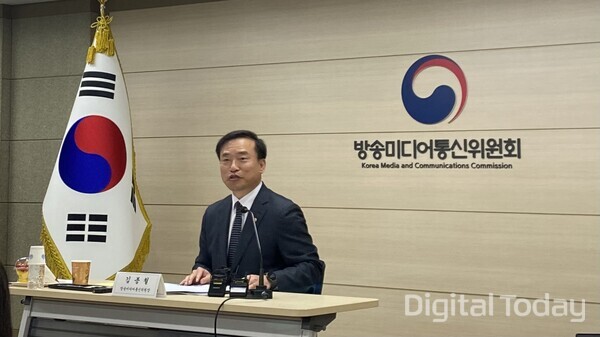
BMCC Chairman Kim Jong-cheol (김종철) said at a news conference marking his first 100 days in office at a government complex auditorium in Gwacheon on March 30 that neither promotion without regulation nor regulation without promotion is sustainable in today's environment of intensifying global media competition. He said the commission is preparing to establish the KBMCPI.
Kim added that he sees the institute's establishment as a small vessel carrying the vision of the BMCC fulfilling its role in linking regulation and promotion systems. He said that, with related bills already introduced in the National Assembly, the commission will actively support the legislative discussion process so a reasonable and effective system can be 마련ed after 충분히 gathering views from various sectors of society.
The BMCC set its future operating direction as establishing a fair order, restoring and strengthening trust in media, and leaping forward in the AI era.
The KBMCPI plan will be 추진 as part of establishing a fair order. It is an integrated promotion body under the BMCC to be created by merging the Korea Media Foundation and the Korea Broadcast Advertising Corporation. The key point is to consolidate within the BMCC the broadcasting industry promotion functions that, even after the BMCC's launch, remain dispersed across bodies including the Ministry of Science and ICT and the Ministry of Culture, Sports and Tourism.
Legislation is also under way at the National Assembly. On March 16, Kim Hyun (김현), a lawmaker from the Democratic Party who serves on the National Assembly's Science, ICT, Broadcasting and Communications Committee, introduced a bill to partially amend the Framework Act on Broadcasting and Communications Development. The bill's key point is to establish the KBMCPI by merging the Korea Media Foundation and the Korea Broadcast Advertising Corporation. The institute will carry out 34 projects including promoting broadcast media, protecting viewers' rights and interests, revitalising the broadcast advertising industry, preventing the distribution of illegal and harmful information, and operating a transparency centre. The bill sets its effective date as Jan. 1, 2027.
Kim avoided a specific answer on the budget size for the KBMCPI. He said the detailed scope of projects should be decided by adding to previously studied content, reflecting demands from the broadcasting sector and referencing the BBC's innovation cases. He said input from a range of stakeholders, including the National Assembly, media-related organisations and broadcasters, is needed for substantial and reasonable promotion policies.
He also said he would support the establishment of a tentatively named Media Development Committee under the Office for Government Policy Coordination, to institutionalise a public forum basis for integrated discussions on the legal and institutional foundation, including the Audiovisual Media Services Act, and on the funding structure for broadcasting and media. He explained that the commission would also aim to turn into visible results efforts to improve outdated regulations, including transitioning the broadcast advertising regulatory system and rationalising programming regulations.
To restore trust in media, the commission will 추진 establishing a transparency centre to respond to false manipulated information and dark patterns. It said it will pursue institutional improvements to strengthen platforms' distribution responsibility for illegal information such as drugs, gambling and sexual exploitation material. It will support discussions with experts and stakeholders together with the National Assembly to prepare measures to address youth overdependence on social media, and it will also revitalise tailored media education by life stage and by group.
To advance in the AI era, the commission will pursue a media sovereignty AI transformation (AX) strategy. Kim said the commission plans to consult with fiscal authorities and actively reflect a related support budget so the introduction of AI within the media industry can be carried out strategically.
Meanwhile, the BMCC, which was launched in October last year, has yet to form its full seven-member lineup. The BMCC consists of seven members: three standing commissioners, including the chairman and vice chairman, and four non-standing commissioners. The president nominates two members, and the ruling and opposition parties' negotiating groups recommend two and three members, respectively. One standing commissioner seat allocated to the People Power Party remains vacant.
Kim said he hopes the remaining standing commissioners, for whom National Assembly recommendation procedures are under way, will be appointed within this week. He expressed a sense of responsibility, saying there have been many shortcomings in addressing issues caused by the gap created by the committee's inability to form a full lineup.
 Seulgi Son
sageson@d-today.co.kr
Seulgi Son
sageson@d-today.co.kr