
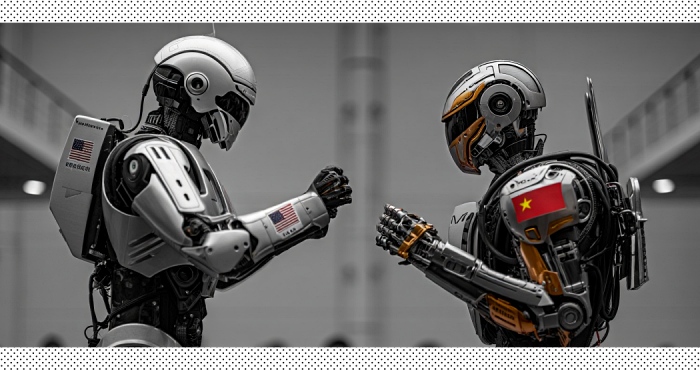
The United States and China are competing in different ways for leadership in the robotics industry.
On March 28, blockchain outlet Cryptopolitan reported that Japan has a stronger presence in the industrial robot market, but the core of the next-generation robot race led by artificial intelligence is concentrated on the United States and China.
The two countries start from different positions. The United States raised $109.1 billion in private AI investment 2 years ago, while China drew $9.3 billion. On the Epoch Capability Index (ECI), a measure that compares overall model capability, Chinese AI models have been assessed as lagging those of the United States by an average of about 7 months since 2023.
China is moving faster in actual robot deployment. China installed about 10 times more robots in its factories than the United States did in 2025. By supplying low-priced robots quickly and at scale, China has expanded its presence to the point that U.S. and South Korean robot companies have raised the need for tariffs to protect domestic firms.
Behind this trend is the Chinese government's all-out strategy to foster the sector. China defines robots as "embodied intelligence" in policy documents, and has actively pushed industrial expansion at both the central and local government levels. The same stance was maintained in a recently reviewed five-year plan for 2026 to 2030, and local governments are also seen competing to attract and nurture robot companies in their regions.
China's push into robotics has a clear reason. Rapid ageing and a shrinking population are deepening labour shortages. According to Reuters, China's population fell for a third straight year through 2024, and a shortage of 50,000,000 blue-collar workers is expected in the future. China is therefore stepping up efforts to replace on-site work shunned by younger people with industrial robots and humanoid robots.
Robot use in China is spreading quickly, centred on industrial sites. According to the International Federation of Robotics, 295,000 robots were installed in Chinese factories last year, the highest annual figure on record. Chinese manufacturers are focusing on developing commercial robots that efficiently perform specific tasks such as auto parts assembly, sorting, welding and assembly processes.
The United States, by contrast, is putting more weight on general-purpose AI-based humanoid robots. The idea is to develop multipurpose robots that can compete with humans and deploy them in both households and manufacturing sites. Tesla's Optimus and Figure AI's Figure 03 are cited as representative examples.
U.S. companies are now moving into a full-scale phase of expanding production. Figure AI last year began operating a high-volume production facility called BotQ that can produce up to 12,000 humanoids a year. Tesla is also preparing to start up its first production line this summer, and is targeting annual output of 1,000,000 units once large-scale production begins in 2027.
U.S. robot companies are generally positioning humanoids as their main products. Examples include Agility Robotics' Digit, Apptronik's Apollo and Boston Dynamics' Atlas. OpenAI was also reported to have set up a humanoid research organisation early this year.
Some assessments say it is still too early to judge whether the U.S. strategy will succeed. Billionaire investor Mark Cuban (마크 큐반) said in a recent livestream that humanoids "could have a lifespan of about 5 years, and after that they could fail miserably. At most, 10 years," showing a sceptical view.
In the end, the U.S.-China robot race is developing into a showdown between China, which leads in scale and commercialisation, and the United States, which is betting on general-purpose AI and next-generation humanoids. It is still too early to say who will be the final winner, but it seems clear that robotics is emerging as the next front in the competition for AI dominance.
 Yoonseo Lee
yslee@d-today.co.kr
Yoonseo Lee
yslee@d-today.co.kr