
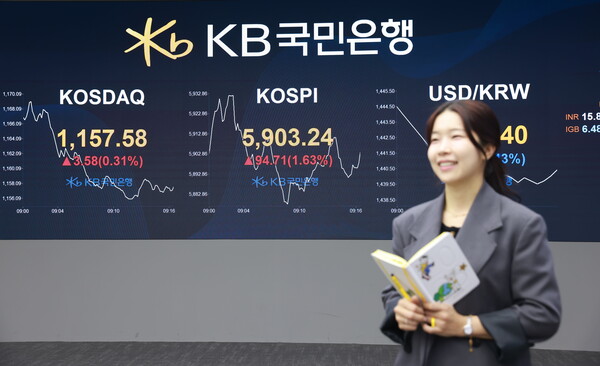
South Korean stocks swung after the U.S. Supreme Court ruled the Trump administration’s reciprocal tariffs illegal. The KOSPI, which at one point eyed the 5,900 level, trimmed gains late in the session as profit-taking selling poured out.
On Feb. 23, the KOSPI ended up 37.56 points, or 0.65 percent, at 5,846.09. The index opened at 5,903.11 and surged as high as 5,931.86 to climb above 5,900, but gains were limited as uncertainty over U.S. trade policy and Middle East risk combined to weigh.
The move in stocks was driven by the U.S. Supreme Court’s decision on Feb. 20 (local time) that the Trump administration’s reciprocal tariffs were unconstitutional.
The court judged that imposing tariffs based on the International Emergency Economic Powers Act (IEEPA) infringed on Congress’ constitutional authority. It immediately invalidated the 15 percent reciprocal tariff that had been applied to major trading partners including South Korea. This is expected to lower the United States’ average effective tariff rate to about 13 percent from 16 percent.
After the ruling, the Trump administration moved immediately. It invoked Section 122 of the Trade Act of 1974 and signed an executive order imposing a 10 percent universal tariff on all imports worldwide from Feb. 24, then announced the next day it would raise it to 15 percent.
The measure is justified as a defence against balance of payments deficits and is applied temporarily for up to 150 days. It expires without a congressional extension, but additional tools are likely to be used, such as Section 301 of the Trade Act or Section 338 of the Tariff Act, which allows tariffs of up to 50 percent.
The impact on South Korean stocks is expected to be mixed. Experts assessed it as "limited direct benefits for South Korea, but reduced downside risks."
With IEEPA tariffs withdrawn, the burden eased somewhat for sectors under trade pressure such as semiconductors. But tariffs on key items such as autos and steel remain in place under Section 232 of the Trade Expansion Act. High tariffs on these items, which account for 35 percent of exports to the United States, continue unchanged at 25 percent for autos and 50 percent for steel.
Semiconductors and AI equipment also remain subject to sanctions based on Section 301 of the trade law. The Office of the U.S. Trade Representative (USTR) has defined South Korea’s network usage fee and online platform law as discrimination against U.S. big tech and is reviewing retaliatory tariffs on IT hardware such as smartphones and laptops.
A 25 percent tariff on semiconductors applied from Jan. 14 includes exemptions limited to certain uses such as data centres in the United States, but that depends on whether companies carry out investments in the United States.
Uncertainty also surfaced in moves by top market-cap stocks. Samsung Electronics rose 1.53 percent and Hyundai Motor gained 2.75 percent to lead the advance, but LG Energy Solution fell 1.37 percent, Samsung Biologics slid 1.09 percent and Hanwha Aerospace was down 0.48 percent. Chemical, energy and defence stocks were mixed on oil price volatility and Middle East risks.
Geopolitical risks linked to Iran’s nuclear issue also weighed on the market. As Trump hinted at military action while setting a deadline for Iran to abandon its nuclear programme, volatility in international oil prices appears to be intensifying.
Geonhyeong Ha (하건형), a researcher at Shinhan Investment Corp, said, "Downside risks are reduced for sectors under trade pressure such as semiconductors, and margins are expected to improve for non-strategic consumer goods such as cosmetics and apparel." He said, "Rising policy uncertainty is expected to stabilise corporate investment sentiment and support a recovery in preference for risk assets such as stocks, and an overall improvement in demand recovery is expected, but Section 232 items such as steel and autos remain a burden."
 Sangyeop Oh
yub@d-today.co.kr
Sangyeop Oh
yub@d-today.co.kr