
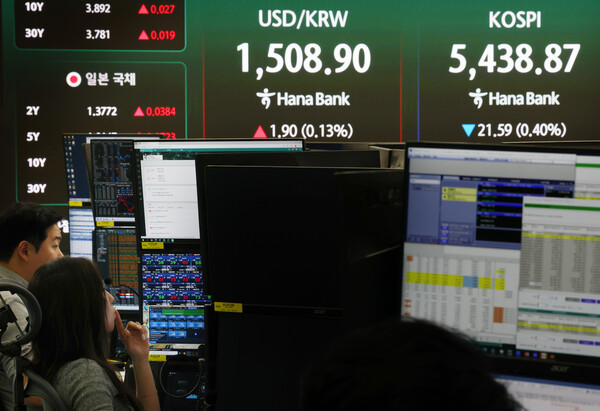
As foreign investors’ net selling of KOSPI shares reached a record about 30 trillion won this month, the average won-dollar exchange rate moved close to 1,490 won, the fourth-highest level on record.
With global risk aversion rising due to the Middle East war, foreign investors are dumping local shares, dealing a direct blow to the won.
Data from the Bank of Korea’s Economic Statistics System and Yonhap Infomax showed the average exchange rate this month through March 27, based on weekly trading closing prices, was 1,489.3 won. That exceeds March 1998 during the foreign exchange crisis at 1,488.87 won, making it the fourth-highest monthly figure on record.
It follows December 1997 at 1,499.38 won, and January 1998 at 1,701.53 won and February 1998 at 1,626.75 won, when the exchange rate surged just after South Korea applied for an International Monetary Fund bailout.
The average exchange rate this year is 1,464.93 won, also the highest since the first quarter of 1998 at 1,596.88 won during the foreign exchange crisis. The gap is about 130 won.
Last week, the exchange rate jumped enough at one point to exceed 1,517 won, pushing the average to 1,503.4 won. On a weekly basis, it returned to the 1,500-won range for the first time in 17 years since the second week of March 2009 at 1,504.43 won during the financial crisis.
Through March 28, the won’s drop against the dollar this month was 4.72 percent, based on New York closing prices, the biggest among major countries.
The dollar index, which measures the dollar’s value against six major currencies, rose 2.6 percent over the same period.
All six currencies that make up the dollar index fell by less than the won: the European Union’s euro, down 2.62 percent; Japan’s yen, down 2.58 percent; the British pound, down 1.64 percent; the Swiss franc, down 3.72 percent; the Canadian dollar, down 1.81 percent; and the Swedish krona, down 4.68 percent.
In Asia, the Australian dollar, down 3.46 percent, the Taiwan dollar, down 2.11 percent, and the offshore Chinese yuan, down 0.84 percent, were also stronger than the won.
Only the Thai baht, down 4.84 percent, the Chilean peso, down 5.48 percent, the Russian rouble, down 5.08 percent, and the South African rand, down 6.90 percent, continued to weaken more than the won.
In addition to the shock from the Middle East war, foreigners are pushing the won lower by offloading KOSPI shares in record amounts for a second straight month.
Foreign investors have net sold 29.8146 trillion won of KOSPI shares this month, surpassing the previous record set last month at 21.0599 trillion won. Total net selling over the two months tops 50 trillion won.
Foreigners dumped 13.3164 trillion won worth of local shares in the past week alone. That is also the biggest on record on a weekly basis, exceeding the previous maximum in the last week of February at 11.7889 trillion won.
Last month, foreigners’ net selling was heavy as they sought to take profits in the KOSPI after strong gains early in the year. This month, net selling is seen as growing as risk aversion from the Middle East war combined with worries over overvaluation in the AI and semiconductor industries.
More recently, Google unveiled new technology that can cut memory demand for running AI models by up to six times, hitting semiconductor shares such as Samsung Electronics and SK Hynix.
Lee Nak-won (이낙원), an FX derivatives specialist at NH Nonghyup Bank, said, "Rising uncertainty over the AI and semiconductor industries and overheating in our stock market affected the exchange rate rise." He said, "While the semiconductor outlook is still good, in a risk-off phase driven by the Middle East war and higher market interest rates, foreigners’ portfolio adjustment is an unavoidable situation."
He added, "The fact that individuals are net buying the KOSPI and supporting share prices is also a condition that is good for foreigners to take profits."
Concerns over South Korea’s economy, which is highly dependent on external energy supplies and has a large share of semiconductor exports, are also cited as a reason foreigners are leaving the local stock market.
Moon Jeong-hee (문정희), chief economist at KB Kookmin Bank, said, "Foreigners’ net selling of shares is continuing due to concerns about the Korean economy, which is highly dependent on Middle East crude oil imports, a preference for safe assets, and a desire to avoid FX losses stemming from concerns about a weaker won." She said, "If the war shrinks the global economy or stagflation emerges, the semiconductor cycle could also see an adjustment."
The prevailing view is that won weakness will last longer even if the Middle East war, which has continued for a month, ends.
Lee said, "Even if the war ends, high oil prices and inflation expectations will ultimately have no choice but to drive won weakness along with concerns about an economic downturn." He expected the exchange rate to fluctuate in a 1,450 to 1,510 won range through the second half of this year.
He said that if the United States deploys ground forces and the war spreads, the exchange rate could break above 1,550 won in a short period.
Park Hyung-joong (박형중), an economist at Woori Bank, said, "If oil prices remain in the 120 to 130 dollar range, the exchange rate’s equilibrium point itself will move to 1,500 won." He said, "Even if the war eases, the possibility of returning to the previous level is limited, and the annual average exchange rate is expected to be above the 1,450 won range, the highest in history."
Baek Seok-hyun (백석현), an economist at Shinhan Bank’s S&T Center, said, "It will take years for already damaged energy facilities in Gulf countries to be normalized, and there is a high possibility that normalization of the Strait of Hormuz will also be delayed." He said, "The possibility of the exchange rate staying in the 1,500 won range has become considerably higher."
[Yonhap News Agency]
 Online Team
d-today@d-today.co.kr
Online Team
d-today@d-today.co.kr