
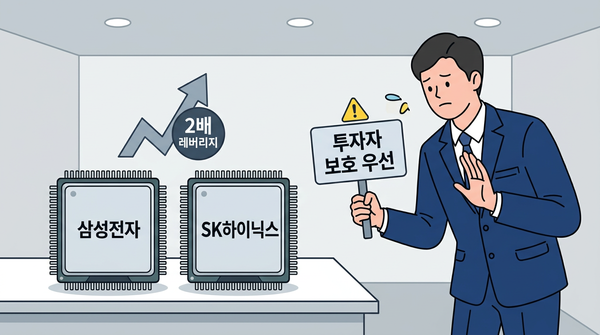
South Korea’s first domestic single-stock 2-times leveraged exchange-traded funds (ETFs), based respectively on Samsung Electronics and SK Hynix, could appear as early as May. Financial authorities are stressing that, given the high-risk structure, investor protection and market-stability measures must be put in place first ahead of the launch.
The financial investment industry and financial authorities said a leveraged ETF that tracks twice a single stock’s daily return is expected to debut in May.
Financial authorities plan to soon disclose detailed rules in the enforcement guidelines for the financial investment business regulations. They are expected to include requirements on the underlying asset’s market capitalisation and trading volume, as well as futures-related conditions that take into account risk diversification and smooth liquidation.
In the domestic ETF market, only index products could be designed with leverage, and products that directly track individual stocks at twice the return were not allowed due to diversification requirements.
At one point, the market speculated that single-stock leveraged ETFs could be allowed for a handful of mega-cap stocks such as Samsung Electronics, SK Hynix and Hyundai Motor.
In February, the Financial Services Commission said detailed measures were still under review in response to related reports, while confirming that some blue-chip stocks such as Samsung Electronics, SK Hynix and Hyundai Motor had been mentioned.
More recently, the prevailing view is that the initial launch targets will be narrowed to Samsung Electronics and SK Hynix, given increased volatility and the possibility of investor losses.
The industry interprets this as authorities seeing as a burden the possibility that, if many stocks are allowed at once, short-term speculative demand could flow in quickly.
Investment demand has already been confirmed. Local investors net bought $7.46 million worth of the Hong Kong-listed "CSOP Samsung Electronics 2x ETF" last month, putting it among the top-traded issues and showing there is substantial demand to buy leveraged products.
SK Hynix has also recently been reported to be pursuing a simultaneous listing in the United States. News has also emerged that a Wall Street asset manager filed an application with the U.S. Securities and Exchange Commission for the listing of the "T-REX 2x Long SK Hynix Daily Target ETF". Interest from domestic and overseas investors is expected to remain high for the time being.
In Hong Kong, products that track twice the returns of Samsung Electronics and SK Hynix are already listed. In South Korea, funds have continued to shift to such overseas-listed products.
The push by authorities to introduce single-stock leveraged ETFs is also interpreted as a calculation aimed at bringing overseas trading value back to the domestic market.
The problem is the risk inherent in the leverage structure itself. A single-stock 2-times ETF doubles gains when the underlying asset rises, but also doubles losses when it falls.
That is why some point out that loss risks are also increasing, with retail investors having put more than 3 trillion won into domestic and overseas leveraged ETFs over the past month.
The concentration of credit-funded money is also growing. The Korea Exchange said outstanding margin loans stood at 32.36 trillion won as of the 20th. By stock, funds were concentrated in major semiconductor names, including 3.0 trillion won in Samsung Electronics and 2.1 trillion won in SK Hynix.
As more money crowds into the same stocks, the risk grows that forced selling could occur in a chain during a downturn, raising concerns that the introduction of single-stock leveraged ETFs could spur market volatility.
The Financial Supervisory Service recently met the Korea Financial Investment Association and asset management company officials to discuss the development of the ETF market and measures to protect investors. At the meeting, the FSS stressed the need to provide accurate information, especially for high-risk products such as leveraged ones.
The idea is to refrain from exaggerated advertising that highlights only the possibility of profits, and to sufficiently explain to investors the loss-amplifying structure and product characteristics.
The FSS also presented tracking-gap management as a key task. As market volatility has increased recently, there have been more cases where the gap between an ETF’s net asset value and market price widens, and an excessive gap can lead to investor disadvantage.
There were also calls for asset managers to provide stable quotes and to conduct pre-impact analysis and improve work processes so that trades do not concentrate at specific times during the rebalancing process before the market close.
Authorities acknowledge that single-stock leveraged ETFs could help expand the market, but they also see the success of the system as ultimately depending on the level of investor protection measures because they are high-risk products.
An industry official said the prevailing view is that, more than the product launch itself, it is more important than initial popularity to decide which stocks to allow and by what standards, and how to design disclosure duties, tracking-gap management and safeguards against concentrated trading. The official said that if the first launch becomes a reality in May, the domestic ETF market will grow, but investors need an approach that checks structural risks before expecting high returns.
 Sangyeop Oh
yub@d-today.co.kr
Sangyeop Oh
yub@d-today.co.kr