
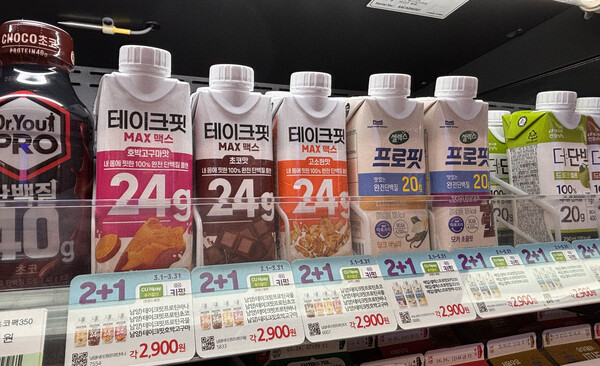
[DigitalToday, reporter Shin-hye Ahn (안신혜)] Dairy companies are stepping up a volume race in ready-to-drink (RTD) protein beverages as the category becomes mainstream. They are also seeking differentiation by expanding into derivative products such as amino acid energy gels.
According to the industry on March 29, Namyang Dairy Products on March 24 launched a renewed version of its Take Fit Monster, increasing protein content to 45 grams. It is the highest protein level among protein drinks currently on the market.
Earlier, Binggrae also introduced a high-protein version of The Protein, raising protein content to as much as 40 grams. Other companies are also known to be considering launching products with increased protein content.
From formula to protein market...grown by dairy industry and spreading to food sector
South Korea's protein market began with powdered products in the form of infant formula and balanced nutrition. As the low birth rate shrank the formula market, dairy companies expanded into adult nutrition, forming the market. Launches by Ildong Foodis and Maeil Dairies of powdered adult nutrition products with higher protein content, based on their formula technology, are cited as the starting point.
Ildong Foodis and Maeil Dairies currently rank among the leaders in the protein drink market. Lotte Chilsung Beverage, Binggrae, Namyang Dairy Products, Orion and even convenience store private brands have since joined, spreading the market across food and beverages.
The market size has grown quickly. According to the Food Industry Statistics Information (aTFIS), South Korea's protein market expanded from 89 billion won in 2018 to 336.4 billion won in 2021, and surpassed 400 billion won in 2023. Last year, it is estimated to have grown to 450 billion to 500 billion won. The industry expects it could reach the 800 billion won range this year. Beverage products account for about 60 percent of the overall protein supplement market.
Rising demand to manage muscle loss and health during the COVID-19 period, when outings were restricted, is also cited as a factor behind the market's expansion. Nutrition supplement products targeting older consumers led early demand, and the consumer base later broadened to all age groups. Ildong Foodis posted sales of 35 billion won in the first year after launching Hi-Mune in 2020, and achieved cumulative sales of 600 billion won in the second half of last year. Sales of the Hi-Mune brand last year were around 150 billion won. Maeil Dairies' Sellex sales also grew 5 percent year on year last year.
Protein drinks that reshaped convenience store shelves...now amino acids and energy gels
Protein drinks succeeded in becoming mainstream following the launch of RTD products. Accessibility improved as the market shifted from powders mixed with water to liquid beverages. As the products moved beyond an exercise supplement image and established themselves as everyday drinks combining taste and health, meal replacement and low-sugar (zero) trends, the consumer base broadened. Protein drinks, once centered on home shopping sales to older consumers, have recently shifted distribution channels to convenience stores and online.
Convenience stores in particular have emerged as a key channel for growth in RTD protein beverages. According to GS25, annual growth rates for protein drinks continued after rapid expansion of 345.7 percent in 2022 and 316.5 percent in 2023, rising 36.6 percent in 2024 and 20.0 percent in 2025. The share of sales to people in their 20s and 30s also exceeded 60 percent. As protein drinks become an everyday option beyond simple supplements, there is also a trend of absorbing some demand for RTD coffee and processed milk.
As the market has grown rapidly, the industry is focusing on strengthening competitiveness, judging that competition based only on taste has limits. As a result, amino acid-based energy gels are emerging as a new trend in the protein drink market. With competition in RTD beverages intensifying, companies are expanding into related markets to differentiate and secure new demand. The competitive field is also widening as pharmaceutical companies, as well as food companies, release related products.
A representative example is Ildong Foodis' Hi-Mune Amino Poten. Related demand is also growing as the running population increases and everyday sports spread. Namyang Dairy Products earlier this month filed trademark applications for energy gels such as Take Fit Booster Amino 2600. According to Namyang Dairy Products, it has no plans to launch an amino acid energy gel product, but it is interpreted as a pre-emptive response as the protein drink market expands into energy gel products.
The industry believes that even if the race to raise protein content continues, a high-content strategy alone has limits for differentiation. It expects competition centered on amino acids and functional products to intensify.
An industry official said, "As competition in the protein drink market grows rapidly, competition is also intensifying." The official said, "The trend of increasing protein content continues, but there are limits to raising content. Companies are working to strengthen competitiveness by diversifying product lines or modifying flavors, so competition is expected to remain intense."
 Shin-hye Ahn
doubletap@d-today.co.kr
Shin-hye Ahn
doubletap@d-today.co.kr