
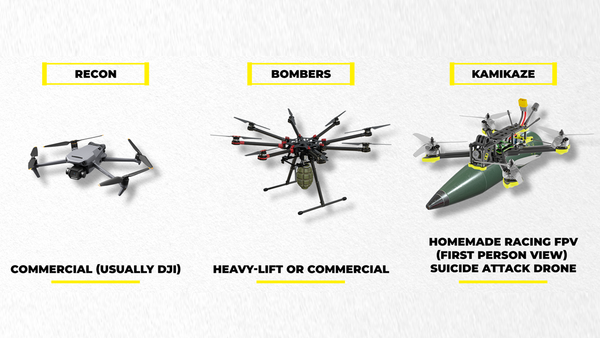
[Digital Today reporter Hyunwoo Choo] The nature of warfare is changing. As drones emerge as key weapons in the Russia-Ukraine war and the U.S. attack on Iran, environmentally friendly hydrogen fuel cells are drawing attention as a new power source.
On March 27 (local time), electric vehicle outlet Cleantechnica reported that as warfare is being reshaped around drones, hydrogen fuel cells are emerging as a power source for military robots and unmanned aerial vehicles (UAVs). Ukraine has already deployed drones across the board, reaching a level that replaces infantry. Andriy Biletsky (안드레이 빌레츠키), commander of Ukraine's 3rd Corps, said, "We will replace 30 percent by 2026, and 80 percent after that, with drones."
The United States is also conducting experiments to apply hydrogen fuel cells to military drones. Michigan startup Sesame Solar has developed a "mobile nanogrid" that uses solar power and hydrogen. One person can assemble the system in 15 minutes, and it can assemble and deploy drones within 5 minutes and supply fuel immediately using a hydrogen tank.
Canadian companies have also joined in. First Hydrogen and Exodus Actuation Solutions announced development of an unmanned ground vehicle combining solar power, batteries and hydrogen fuel cells. They plan to apply it not only to the military but also to various fields such as civilian logistics, security and disaster response.
First Hydrogen is also pushing ahead with hydrogen production using SMRs (small modular reactors). But commercialisation is expected to take time unless cost and safety issues are resolved. The green hydrogen industry in the United States has also faced challenges due to policy changes under the Trump administration, but in the agricultural sector, wind- and solar-based green ammonia production is accelerating.
 Hyunwoo Choo
cookinpapa@d-today.co.kr
Hyunwoo Choo
cookinpapa@d-today.co.kr