
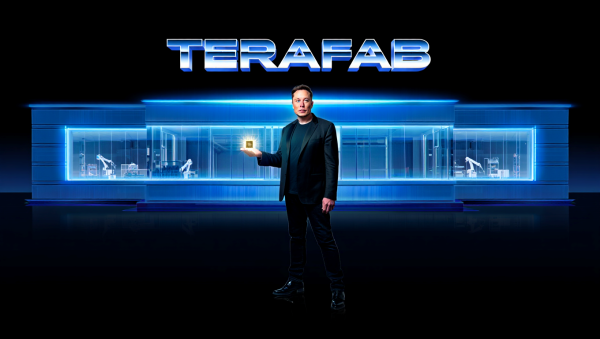
As Elon Musk's Terafab plan gradually takes shape, Tesla and SpaceX are ramping up their battle to secure semiconductor talent. Industry attention is also on Terafab job postings released after Musk unveiled a chip manufacturing plant plan that could be the largest in history.
On March 26 (local time), Business Insider reported that Tesla is recruiting module process engineers with lithography expertise in the U.S. states of California and Texas. Base pay ranges from $88,000 to $240,000. Applicants must have at least 10 years of experience developing advanced semiconductors and must also withstand Tesla's intense work environment. The posting lists requirements including "24/7/365 manufacturing operations support" and "rapid response to critical production issues."
The Terafab division is also hiring process integration engineers to develop advanced logic chips. Base pay for the role ranges from $88,000 to $338,280. Musk has said Terafab will integrate the production of logic chips and memory chips under one roof, an approach seen as unusual even in the semiconductor industry. The wide salary range is also interpreted as reflecting Tesla's compensation system.
Separately, Tesla is hiring silicon engineers in Austin and is also looking for a technical program manager with experience leading capital investment projects worth at least $100 million. The role oversees overall semiconductor plant design and construction. Base pay for these jobs was not disclosed.
SpaceX is also accelerating efforts to secure semiconductor workers. The company last year invested $280 million in Bastrop, Texas to expand semiconductor research and development and packaging facilities, and it has posted about 60 job openings in its silicon division. The hires are expected to be deployed to develop advanced chips used on the ground and in space. It is not yet clear, however, which of these roles is directly connected to Terafab.
These include a posting seeking assembly and packaging engineers at Starlink's plant in Bastrop, Texas. SpaceX is also hiring special-chip development staff in the U.S. states of Washington and California for chips to be used in space and on the ground. The Bastrop posting says, "In typical SpaceX fashion, Starlink is bringing integrated-circuit packaging and assembly in-house into a vertically integrated development and production system, advancing vertical integration by one more step," but it did not include salary information.
The successive hiring expansion by Tesla and SpaceX is seen as a sign that Terafab is moving beyond a simple concept and into an execution phase. In particular, the effort to bring semiconductor design and manufacturing entirely in-house is also interpreted as an extension of Musk-style vertical integration.
Still, the goal of building a new semiconductor production system on a global top scale will be difficult to achieve without securing talent and building up manufacturing capabilities. In the end, an assessment is emerging that Terafab's success or failure depends less on Musk's concept itself than on how quickly it can attract the people needed to turn it into an actual factory and organisation.
 Yoonseo Lee
yslee@d-today.co.kr
Yoonseo Lee
yslee@d-today.co.kr