
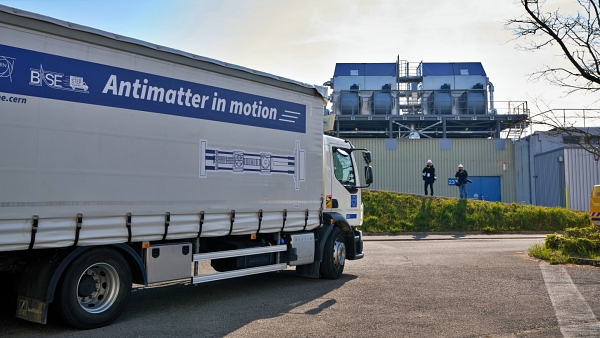
[DigitalToday reporter Jinju Hong (홍진주)] The European Organization for Nuclear Research, CERN, has for the first time succeeded in transporting 'antimatter' by truck.
On March 26, local time, online media outlet Gigazine reported that CERN said its in-house BASE experiment team succeeded in transporting 92 antiprotons, the antimatter counterpart of protons, to another location. It marked the first time antimatter was directly moved between different sites using an antimatter storage container. The truck used for the transport travelled more than 8 km for about 30 minutes and is known to have reached a top speed of 42 km per hour.
At the core of the achievement is the mobile antimatter storage device BASE-STEP. The system integrates a superconducting magnet, a cryogenic cooling system and a vacuum chamber. It is designed to stably store and transport antiprotons while confining them with magnetic and electric fields. The device weighs about 1 ton, but was miniaturised so it can be loaded onto a truck and taken in and out of laboratories, and it can withstand vibrations while driving.
Because antimatter annihilates immediately on contact with matter, maintaining high vacuum and cryogenic conditions during transport is a key technology. BASE-STEP is seen as technically significant because it meets those conditions while also ensuring mobility.
The transport was driven by the need to secure a precision measurement environment. CERN's internal antimatter production facility had limitations for ultra-precise experiments because it experienced slight magnetic field fluctuations, and researchers attempted to move outside to measure the antiproton's magnetic moment in a more stable environment.
The BASE experiment team aims to precisely analyse the properties of antiprotons to determine why only matter remained in the universe while antimatter disappeared. Antimatter is a particle that is almost identical to matter but has opposite charge and other properties, and CERN is the only place on Earth where it can be artificially created for study.
The team plans to expand transport to other buildings within CERN and conduct experiments to move antiprotons between devices. It also aims to transport them to a German research institute about 700 km away in 2029, and is reviewing a plan to mount a generator on the truck to maintain a cryogenic state of about 8.2 K or below.
CERN sees the result as a new turning point for antimatter research. It is assessed that if mobile antimatter transport technology is established, research previously limited to specific facilities could be expanded worldwide, and it is expected to provide an important clue to solving the fundamental asymmetry problem of the universe.
 Jinju Hong
hongjj@d-today.co.kr
Jinju Hong
hongjj@d-today.co.kr