
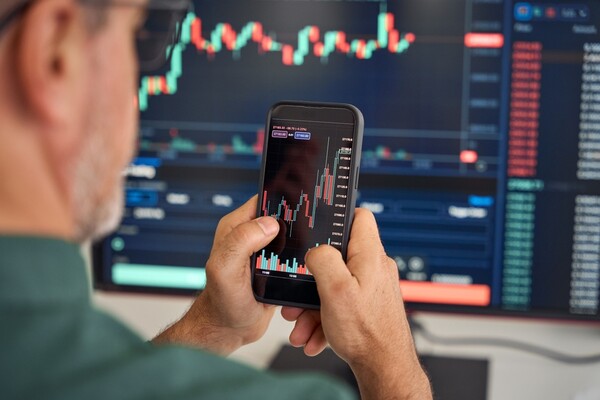
South Korean brokerages are sequentially adding artificial intelligence-based services to their mobile trading systems (MTS). But repeated MTS system outages mean questions over system stability remain a task, critics say.
In the financial investment industry, brokerages have introduced AI-based market summaries, stock reports, video content and real-time issue analysis to their MTS since the start of this year, the sector said on March 27.
Kiwoom Securities said users of its AI-based workplace counselling chatbot service recently topped 300,000. The chatbot uses generative AI to provide tailored answers even to complex queries. If the AI response is not sufficient, it is structured to connect users directly to a chat consultation with a specialist agent.
Woori Investment & Securities introduced an AI-based stock analysis service called "AI Report" on its MTS, "WooriWON MTS". It provides investment insights by having AI reconstruct, interpret and analyse data for about 700 major domestic and overseas stocks.
Toss Securities launched an AI-based "real-time issues" service. It analyses vast information such as news and disclosures and provides a ranking of 20 key issues with high market influence. Using an in-house "ontology" technology developed by Toss, it analyses in a linked structure how a specific issue affects related industries and companies.
Shinhan Investment Corp provides video content produced by AI every Friday on a regular basis, based on weekly stock market commentary published by its research centre.
Daishin Securities allows users to view overseas company disclosures in an AI-translated and summarised form directly within its MTS, and to grasp company earnings and dividend information using AI. It also provides AI-automated translations and summaries of news on overseas companies and markets from U.S. local media outlets.
As competition among brokerages over MTS-centred AI services accelerates, some also say MTS could move beyond a simple trading channel and establish itself as a comprehensive financial platform.
But frequent MTS system outages remain an unresolved task. Since the start of this year, MTS errors have occurred in succession at multiple brokerages including Korea Investment & Securities, Kakao Pay Securities, Toss Securities and LS Securities.
Another problem is that even access to customer centres is virtually paralysed when system outages occur. Brokerages guide customers to place emergency orders through ARS or customer centres when outages occur, but in situations where access traffic concentrates, it is difficult to make an actual call connection.
As work structures have recently changed in a direction where AI services replace existing manpower, a side effect is also emerging in which practical consultation channels that users can rely on when outages occur are instead shrinking.
Even in this situation, brokerages mostly cite "traffic issues" as the cause of errors and have failed to present specific improvement measures. On expanding consultation staff, most brokerages say it is not easy to increase headcount because consultation work is also shifting to an AI-based model.
Authorities are also watching the situation. Financial authorities recently summoned financial industry officials and urged them to prevent a recurrence of system incidents. In particular, Financial Supervisory Service Governor Lee Chan-jin (이찬진) warned, "If system incidents occur due to weak internal controls, I will impose monetary penalties."
An official in the brokerage industry said, "With limited manpower and resources, using AI is essential everywhere to survive competition," and added, "Along with AI services provided to customers, the AI domain that handles company work will also gradually expand."
Meanwhile, the Korea Exchange said that the share of MTS executions stood at 65.7 percent, or 1.354 quadrillion won, out of individuals' cumulative trading value in the domestic stock market of 2.06 quadrillion won from the start of this year to early this month. The number of stock trading active accounts, which was 98,290,000 at the end of last year, recently surpassed 102,760,000.
 Sangyeop Oh
yub@d-today.co.kr
Sangyeop Oh
yub@d-today.co.kr