
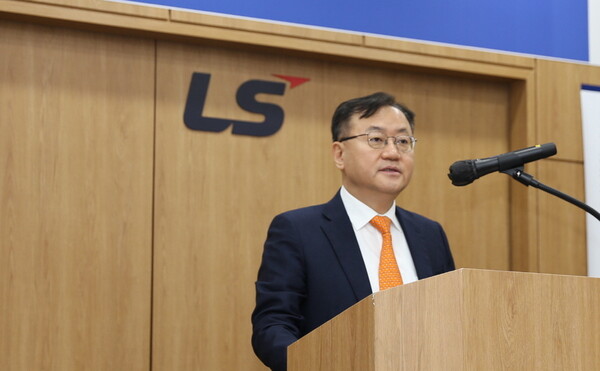
LS declared a two-track strategy to pursue both expansion of its power business and stabilisation of new businesses despite global uncertainty. Chief Executive Myung Noh-hyun (명노현) on March 26 set out three management tasks for this year at the company’s 57th annual general meeting: settling U.S. localisation investment, early stabilisation of its battery and electric-vehicle parts business, and embedding AI-based innovation.
Myung said this year’s business environment is a phase in which both opportunities and uncertainty are expanding. He cited a boom in the global power market, the West Coast energy highway and expansion of the AI industry as opportunity factors. He said changes in U.S. external policy and prolonged inflation are expected to act as risks. "With cool-headed judgement and swift execution, we plan to advance LS' future value," he said.
The backdrop to the strategy is last year’s results. LS posted 31.87 trillion won in 2025 revenue and 1.1 trillion won in operating profit, recording its highest-ever revenue and achieving 1 trillion won in operating profit for a second consecutive year. LS Electric and LS Cable & System expanded orders for high value-added products such as extra-high-voltage transformers, submarine cables and busducts, building an order backlog of more than 12 trillion won as of the end of last year, the company said. LS MnM increased net profit on rising copper prices and improved profitability in its sulfuric acid and precious metals business, while LS Mtron increased operating profit on expanded sales in North America.
U.S. localisation is key in the power business. It plans to build a local production base by establishing submarine cable and busduct plants and expanding a switchboard plant. "We will strictly manage investment priorities so LS can combine business growth with financial strength on the back of stable cash flow," Myung said.
In new businesses, it will focus on early stabilisation of its battery materials and electric-vehicle parts business. It aims to overcome a temporary slowdown in demand for electric vehicles, the so-called chasm, and deliver tangible results. It will also push supply-chain diversification to reduce reliance on specific markets and customers. That is based on its judgement that geopolitical risks could shake supply chains.
It will also seek to improve productivity by introducing AI across sales, production and research and development. "We will continue relentless innovation activities throughout this year so innovation through AI is embedded in processes and organisational culture and emerges as sustainable competitiveness," Myung said. He also presented a plan to increase dividends tied to improved business performance.
 Daegeon Seok
d2dg@d-today.co.kr
Daegeon Seok
d2dg@d-today.co.kr