
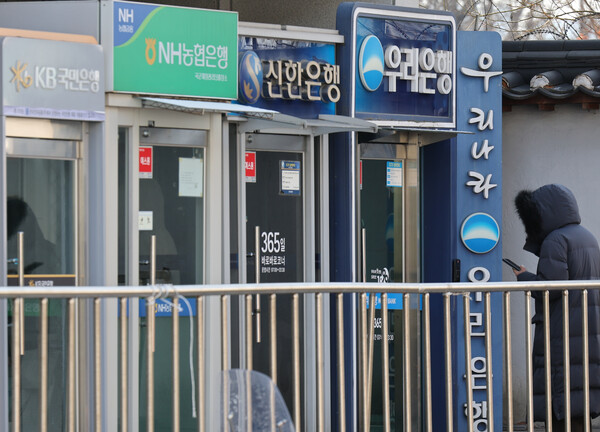
[Digital Today reporter Ji-young Lee] Banks are moving one after another to introduce a “4.9-day workweek”. Some see the spread of the system, centred on early departures on Fridays, as changing branch operations and the structure of customer touchpoints rather than simply cutting working hours.
In the financial sector, NH NongHyup Bank will implement an early-departure scheme from March 27, bringing forward the Friday quitting time by 1 hour to 5 p.m. from 6 p.m. Counter service hours will remain the same, from 9 a.m. to 4 p.m.
IBK Industrial Bank of Korea and KB Kookmin Bank have already introduced a 4.9-day workweek. Major commercial banks such as Shinhan, Hana and Woori are also likely to introduce it within this year.
The 4.9-day workweek was agreed through industry-wide wage talks between the Korean Financial Industry Union and the Korea Financial Industry Employers Association in October last year. It is a compromise that keeps the five-day workweek while partially reducing working hours. Banks are pursuing both better work-life balance and improved organisational efficiency through it.
Still, shorter working hours mean fewer staff hours. With counter operating hours maintained, it becomes difficult to run branches in the same way as before, and banks are responding by redesigning branch functions and operating methods.
The key is separating “time” and “function”. The shift is under way from a structure in which the same staff responded during the same business hours to one that divides roles by time slot and by channel.
KB Kookmin Bank, for example, is expanding its “9 To 6 Bank,” which operates until 6 p.m., to capture financial demand after work. It splits staff into a morning shift and an afternoon shift, reducing working hours while extending service hours instead.
Shinhan Bank’s digital lounge and AI branch follow the same flow. The strategy is not simply to extend business hours but to subdivide branch functions to raise operating efficiency.
The digital lounge operates as Evening Plus on weekdays from 9 a.m. to 9 p.m., and as Saturday Plus from 9 a.m. to 5 p.m. on Saturdays. The AI branch can handle a total of 64 tasks, including foreign currency exchange and new check card issuance, and operates 365 days a year, from 9 a.m. to 8 p.m., including Saturdays and public holidays.
Hana Bank has introduced the “Hana 9 o’clock Lounge,” which operates until 9 p.m. on weekdays. It is an unmanned branch based on video consultations, allowing key financial tasks to be handled after business hours. It is seen as a case of separating some face-to-face counter functions into a digital channel.
Woori Bank introduced unmanned branches with digital desks and kiosks under “Digital Express”. Operating hours are from 9 a.m. to 9 p.m. on weekdays, and from noon to 6 p.m. on weekends and public holidays.
NH NongHyup Bank is expanding both flexible branches and unmanned branches in parallel. Through “Early Bank” and “After Bank,” it is dispersing time slots, while shifting simple tasks to non-face-to-face channels through its AI-based unmanned branch, “NH Digital Station”.
Banks’ diversification of branch operations alongside shorter working hours is seen as an inevitable choice to maintain both staff efficiency and customer touchpoints. Mobile finance has spread, but demand for face-to-face channels remains in some areas, such as loan consultations and services for older customers.
Ultimately, the 4.9-day workweek is acting as a catalyst for redefining the role of bank branches rather than remaining a simple change in working arrangements. A shift is taking shape in which face-to-face counters focus on consultations while simple tasks move to digital channels.
A financial industry official said, “As shorter working hours make changes in staffing operations inevitable, branch operating structures are also changing.” The official added, “It is a transition process to secure both efficiency and customer convenience.”
 Ji-young Lee
ljy@d-today.co.kr
Ji-young Lee
ljy@d-today.co.kr