
As conflict between the United States and Iran heightens uncertainty in global fossil fuel supply chains such as oil and gas, renewable energy is emerging rapidly as a strong alternative.
That sense of macroeconomic crisis has been reflected in South Korea's stock market. SK Eternix, which operates renewable energy businesses including solar, wind, fuel cells and energy storage systems, traded at 56,300 won as of March 25. That is up 168% from an intraday low of 20,950 won on the 4th, shortly after the outbreak of war.
Some in the market also view the rise with concern, questioning whether it is a short-term, theme-driven rally leaning on geopolitical risk. But an analysis says that a look into SK Eternix's business structure suggests it is at the beginning of structural growth beyond a simple theme stock.
The basis for the share price rise can be found in its profit structure. SK Eternix chose a strategy of directly owning and operating generation assets instead of the industry’s typical model of developing and then selling. It sells renewable energy certificates under 20-year long-term fixed-price contracts, lowering cost volatility and securing stable profits.
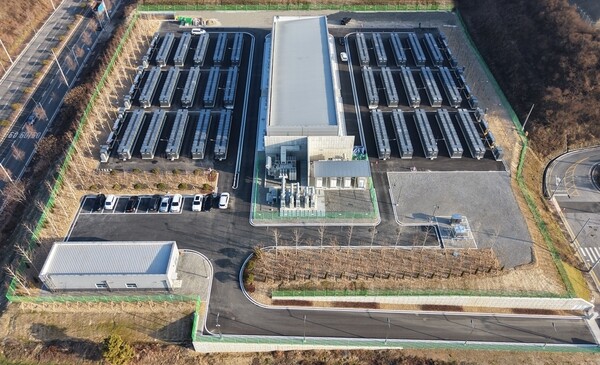
Its business portfolio consists of solar, wind, fuel cells and ESS. In solar, it currently operates about 180 megawatts and plans to expand to 150 to 200 megawatts a year from 2026. In wind, it operates 158 megawatts of onshore capacity, and upon completion of the Uiseong Hwanghaksan wind project under construction, at 99 megawatts, it will rise to 257 megawatts and become South Korea's largest private onshore wind operator.
In offshore wind, it is developing a total of 1,345 megawatts, including Sinan Ui at 390 megawatts and Incheon Gulupdo at 755 megawatts. In fuel cells, it currently operates 129 megawatts across 6 sites, and when 71 megawatts under construction is completed, it will have an operating system totaling 200 megawatts.
◆ESS domestic share 20% and entry into Texas... aiming to become a VPP operator
Results are solid. Based on SK Eternix’s business report, 2025 annual revenue was 385.6 billion won and operating profit was 53.0 billion won, up 16 percent and 41 percent, respectively, from a year earlier. The renewable energy division posted revenue of 348.9 billion won and operating profit of 59.0 billion won, with revenue up 14 percent and operating profit up 39 percent from a year earlier.
The ESS division also posted revenue of 36.8 billion won and operating profit of 8.7 billion won, with revenue up 33 percent and operating profit up 74 percent from a year earlier. In both divisions, revenue and operating profit grew together, proving the sturdiness of its profit base. Total assets jumped nearly 80 percent, from 731.7 billion won a year earlier to 1.32 trillion won, and the pace of expansion also steepened.
In particular, its ESS business holds about 20 percent of South Korea’s peak-shaving market and entered the global market by completing 100 megawatts in Texas. SK Eternix aims to build energy data analysis capabilities based on ESS and expand as a virtual power plant operator in the future. It plans to develop into a solutions company that analyzes customers’ energy consumption data to solve problems in the national power grid.
Solanix, a long-term growth driver, also looks promising. Solanix is SK Eternix’s financial structuring business for solar generation assets. It operates solar plants directly and structures financial products using the cash flow generated there as collateral. The company buys solar generation assets, owns and operates them, and expands earnings by creating financial structuring products such as 'Solanix No.1' based on those assets.
The Solanix business scale expanded from 40 megawatts in 2024 to about 130 megawatts in 2025, and it plans to increase to 150 to 200 megawatts a year from 2026. Kiwoom Securities estimated Solanix revenue at 36.4 billion won in 2025 and 49.0 billion won in 2026, and projected it will exceed 100.0 billion won in 2029.
According to the 11th Basic Plan for Electricity Supply and Demand, power demand from semiconductors and data centres in 2025 to 2030 is expected to increase by an annual average of 6.7 terawatt-hours, and demand for renewable energy is also expected to grow. Uncertainty remains, however, related to the sale of the largest shareholder’s stake. Kiwoom Securities forecast that if a foreign infrastructure fund acquires the stake, the size and scope of investment could expand, and it expects demands for shareholder returns to rise over the medium to long term.
 Suk Dae-geon
d2dg@d-today.co.kr
Suk Dae-geon
d2dg@d-today.co.kr