
[Digital Today reporter Oh Sang-yup] The Financial Intelligence Unit and the Financial Supervisory Service on March 26 released the results of a survey on domestic digital asset service providers for the second half of 2025. The survey covered 27 digital asset service providers, including 18 exchanges and nine wallet and custody operators.
Financial authorities said user accounts and won deposits at digital asset exchanges rose, but trading volume, operating profit and market capitalisation fell.
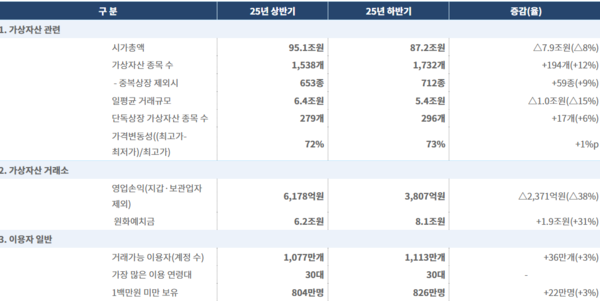
As of end-2025, the market capitalisation of digital assets in South Korea stood at 87.2 trillion won, down 8 percent from 95.1 trillion won at end-June. Average daily trading in the second half was 5.4 trillion won, down 15 percent from 6.4 trillion won in the first half. Exchanges' operating profit and loss was 380.7 billion won, down 38 percent from 617.8 billion won in the first half.
The number of tradable user accounts rose 3 percent to 11.13 million from 10.77 million at end-June. Users' won deposits increased 31 percent over the period to 8.1 trillion won from 6.2 trillion won.
On market trends, prices were strong through early October on expectations of a U.S. policy rate cut and pro-digital asset policies, but later fell as uncertainty grew, including U.S.-China trade tensions.
In particular, after October, funds from institutional investors continued to flow out, mainly into U.S. spot bitcoin exchange-traded funds, increasing market volatility. Bitcoin was priced at $87,509 at end-2025, down 18 percent from $107,135 at end-June.
The number of digital assets traded in South Korea was 1,732, including duplicates, up 194 from 1,538 at end-June. Excluding duplicates, the number of tokens rose by 59 to 712.
Digital assets listed exclusively on a single exchange totalled 296, up 17 from 279 at end-June. Of these, 43 percent, or 128, were small with a market capitalisation of 10 million won or less, showing a need for caution over market risks such as low liquidity and sharp price swings.
Digital asset price volatility, measured as the decline from the peak, was 73 percent, up 1 percentage point from 72 percent in the first half. This was far higher than the declines from the peak over the same period for the KOSPI at 28.3 percent and the KOSDAQ at 18.8 percent.
New trading support, or listings, in the second half totalled 250 cases, up 8 percent from 232 in the first half. Trading suspensions, or delistings, totalled 66 cases, up 14 percent. Project risk accounted for 59 percent of the reasons, followed by other at 24 percent and technology risk at 14 percent.
The amount of digital assets transferred out from exchanges was 107.3 trillion won, up 6 percent from 101.6 trillion won in the first half.
Travel rule-applied transfers totalled 15.6 trillion won, down 23 percent from 20.2 trillion won in the first half. Transfers on a whitelist to pre-registered overseas operators and personal wallets totalled 90.0 trillion won, up 14 percent.
By age group, people in their 30s accounted for the largest share at 27 percent, followed by those in their 40s at 27 percent, 50s at 19 percent, 20s and younger at 19 percent, and 60s and older at 9 percent. Among all tradable users, 74.2 percent, or 8.26 million people, held less than 1 million won in assets.
Total assets under custody at wallet and custody operators were 307.1 billion won, down 58 percent from 739.8 billion won at end-June. The main reason was a decline in reference prices for some custodied digital assets. The number of employees rose 24 percent to 240 from 193 at end-June.
 Oh Sang-yup
yub@d-today.co.kr
Oh Sang-yup
yub@d-today.co.kr