
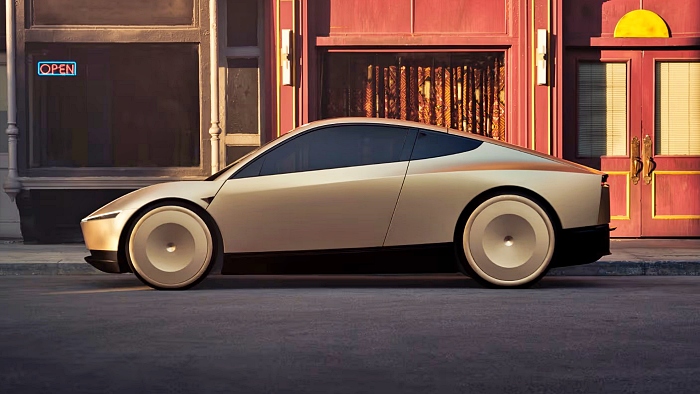
[DigitalToday intern reporter Kyungmin Hong (홍경민)] Tesla is introducing a new type of door release device that integrates electronic and mechanical functions in its next-generation Cybercab robotaxi to help occupants exit safely in emergencies. The move marks a full-scale design change.
InsideEVs reported on March 24 that a new pull-up door lever was spotted inside the recently revealed Tesla Cybercab, replacing the existing button-based opening system. The change is seen as an effort to address safety controversies over Tesla's electronic button system, which has been criticised for failing in emergencies or being complicated to use.
■ Tesla door design controversy grows amid concerns over fatal accidents Tesla pursued a design change as safety accident concerns continued over its distinctive door-handle structure. Bloomberg reported that Tesla's existing door-handle design has been cited as a cause of multiple injury accidents and is known to be linked to at least 15 fatal accidents last year. Critics say damage grew because occupants could not intuitively find an exit in urgent situations such as accidents.
As such accidents and controversy continued, calls grew to question Tesla's door design approach. Tesla has applied a method of placing a mechanical lever in a separate location for emergencies. That was intended to prevent occupants from accidentally operating the device and damaging exterior glass or trim. Critics have said accessibility is low for rear seats because the emergency release is hidden behind the speaker grille or under the lower panel of the door pocket.
■ Two-stage lever integrating electronic and mechanical functions introduced To respond to the safety controversy, Tesla introduced a two-stage lever structure that integrates electronic and mechanical release functions into a single lever, first shown on the Cybercab. Videos released by YouTube channels Kim Java (킴 자바) and Josh West (조시 웨스트) show that pulling the lever slightly opens the door electronically as usual, but pulling it deeper in an emergency mechanically releases the latch and opens the door regardless of whether power is supplied.
This is a case in which a mechanism previewed last year by Tesla chief designer Franz von Holzhausen is implemented in practice. He previously said it was being designed so that even in a panic situation, people could use instinctive muscle memory to escape by pulling the lever harder in a familiar location to enable mechanical release. The lever surface also includes a braille engraving indicating Open to make it easy to find for the visually impaired or in dark conditions.
■ Attention on whether it will be applied to the existing lineup It has not been officially confirmed whether the new door lever is exclusive to the Cybercab or will also be applied to Tesla's existing mass-production lineup such as the Model 3 or Model Y. Tesla is holding back on whether the latch design is a new standard, but the industry sees a strong chance it will be expanded to all models to comply with regulations and improve safety.
In particular, Tesla's move suggests it is starting to put more weight again on the essential safety value of saving lives in emergencies than on design aesthetics. It is expected to help reduce confusion for first-time Tesla passengers when getting out and contribute to improving survival rates in extreme situations where power is cut.
 Kyungmin Hong
hongm@d-today.co.kr
Kyungmin Hong
hongm@d-today.co.kr