
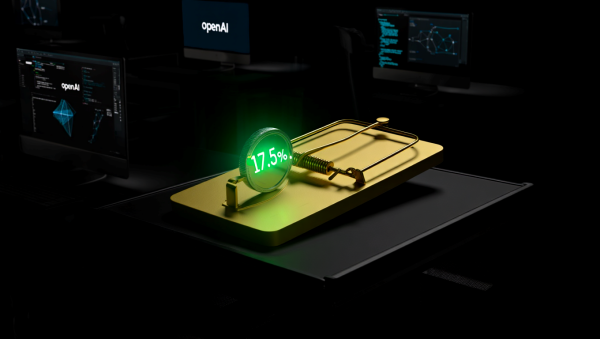
OpenAI is seeking a structure that guarantees private equity investors a 17.5 percent return, stirring debate in the market over whether it is sustainable. Critics say an aggressive fundraising strategy touting high returns may boost investor appetite while also recalling past crypto market collapses.
Reuters, cited by blockchain outlet BeInCrypto on March 24 local time, reported that OpenAI plans to set up a joint venture with major private equity firms including TPG, Advent International, Bain Capital and Brookfield Asset Management to issue about $10 billion of preferred stock. About $4 billion of that would be financed by external investors, and OpenAI is said to have offered terms including a guaranteed annual return of 17.5 percent and priority access to its artificial intelligence models to attract investment. The return is far higher than typical preferred shares.
Some market experts have raised strong concerns about the structure. Alex Svanevik (알렉스 스바네빅), CEO of Nansen, said the return structure is similar to past cryptocurrency projects that promoted fixed returns. Terra’s Anchor Protocol promised returns of 19 to 20 percent to draw funds, but about $40 billion in value later collapsed as investor trust crumbled.
Edward Dowd (에드워드 다우드), a former BlackRock portfolio manager, also criticised it as a "typical sign of a bubble" and warned that high fixed returns could distort the market.
OpenAI’s financial structure is also behind the debate. OpenAI posted about $20 billion in revenue in 2025, up 233 percent from a year earlier, but aggressive infrastructure investment and rising operating costs are expected to result in a loss of about $14 billion in 2026. That means profitability has yet to be clearly secured despite rapid revenue growth.
For these reasons, some investment firms have hesitated or withdrawn. Software-focused investor Thoma Bravo pulled out of the investment, questioning long-term profitability, and some private equity firms are reported to have declined to join the joint venture due to concerns over economic viability.
Some counter that it is difficult to place OpenAI’s structure on the same footing as past crypto cases. OpenAI generates stable revenue based on actual corporate customers and APIs, and its business foundation differs from Terra, which relied on speculative inflows.
Rival Anthropic is also pursuing a similar fundraising approach, but differs in that it does not guarantee a fixed return. For that reason, some interpret OpenAI’s 17.5 percent return offer as a sign that attracting investment may be harder than expected.
The market is watching whether OpenAI’s choice is a strategic gambit or a signal reflecting overheated AI investment fervour.
 Jinju Hong
hongjj@d-today.co.kr
Jinju Hong
hongjj@d-today.co.kr